



Estimated reading time: 18 minutes
A traveller planning a weekend away may no longer begin with ten blue links. They might ask ChatGPT, Google AI Mode, Microsoft Copilot or another AI search experience for “a quiet boutique hotel near the old town with parking, breakfast and walkable restaurants”. The system then has to work out which properties genuinely fit that request, which facts it can trust, and which sources it can use to support the answer.
That changes the discovery journey for hotels, but it does not make conventional SEO obsolete. The practical goal of hotel AI search optimization is to make your property easier to discover, understand, verify and recommend across the web. That means strong technical SEO, unusually clear property information, useful traveller-focused content, accurate local and third-party listings, and a website that turns recommendation intent into a direct-booking path.
This guide explains what to optimise in 2026, what not to waste time on, and how an independent hotel can build an AI-search programme without chasing speculative shortcuts.
What is hotel AI search optimisation?
Direct answer
Hotel AI search optimization is the process of making a hotel’s public information easy for AI-powered search systems to crawl, interpret, verify and use when answering traveller questions. The strongest approach combines normal SEO with clear property positioning, accurate hotel data, structured markup, useful first-party content, consistent Business Profile and OTA information, credible external mentions, and ongoing measurement. No hotel can guarantee an AI recommendation, but it can remove the ambiguity and access problems that make recommendation less likely.
| By | Daniel Rey, Hospitality Growth Strategist, WaveBNB |
| Last updated | August 2026 |
| Experience | 9+ years in growth marketing, demand generation, SEO, paid acquisition, CRO, analytics and digital strategy across B2B SaaS, technology and hospitality. Experience managing multi-channel advertising budgets of up to £200k per month. |
| Editorial note | Content is reviewed and updated as search platforms, AI discovery, advertising systems, hospitality technology and digital marketing best practices evolve. |
| Sources | Google Search Central; Google Business Profile Help; OpenAI Help Center; Microsoft Bing Webmaster; Schema.org. |
About the author
Daniel Rey is the Hospitality Growth Strategist at WaveBNB, specialising in helping independent hotels, boutique properties, resorts, vacation-rental operators and property management companies improve visibility, generate more profitable direct demand and convert more travellers into guests.
Daniel brings 9+ years of experience across growth marketing, demand generation and digital strategy, with expertise spanning SEO, Google Ads, paid social, CRO, lifecycle marketing, analytics, content strategy and AI automation. He has managed multi-channel advertising budgets of up to £200k per month and built acquisition and conversion programmes focused on measurable commercial outcomes rather than vanity metrics.
Through WaveBNB, his work focuses on the complete hospitality growth journey, from hotel SEO and AI-search visibility through paid acquisition, direct-booking conversion, analytics and AI-powered guest experiences. His approach connects visibility, qualified traffic and booking intent to direct revenue, conversion efficiency and sustainable hospitality growth.
Key takeaways
- AI-search visibility starts with SEO fundamentals. Google explicitly says its generative search features are rooted in core Search ranking and quality systems.
- A hotel should make its identity, location, room types, amenities, policies, audience fit and booking path unambiguous in crawlable text, not only in images or widgets.
- Keep the same core facts consistent across the hotel website, Google Business Profile, hotel feeds, OTAs and other important public listings.
- Use Hotel or LodgingBusiness structured data to describe factual information that is already visible on the page. There is no special ‘AI schema’ required by Google.
- Allow the crawlers needed for the AI surfaces you care about. For ChatGPT Search, OpenAI says OAI-SearchBot access is important for inclusion.
- Build differentiated, experience-led content around real traveller decisions instead of publishing dozens of thin pages for every prompt variation.
- Measure AI visibility separately from ordinary rankings using Search Console’s generative AI reporting where available, Bing AI Performance, referral analytics and a controlled set of recurring traveller prompts.
Table of contents
- What is hotel AI search optimisation?
- 1. What hotel AI search optimisation actually means
- 2. How AI-powered search finds and evaluates hotel information
- 3. The AI Recommendation Readiness framework for hotels
- 3.1 Make the hotel entity unmistakably clear
- 3.2 Publish the factual property information travellers actually compare
- 3.3 Define who the property is genuinely a good fit for
- 3.4 Keep your public hotel facts consistent
- 3.5 Create distinctive first-party content
- 3.6 Make the site technically easy to retrieve
- 3.7 Give the recommendation somewhere useful to go
- 4. How to optimise the pages that AI systems need most
- 5. How to write for conversational hotel searches without creating thin content
- 6. Technical SEO and crawler access for AI search
- 7. Structured data for hotels: what it can and cannot do
- 8. Reviews, listings and third-party corroboration
- 9. What not to do for AI search optimisation
- 10. How to measure hotel visibility in AI search
- 11. A 30-day hotel AI-search implementation plan
- Frequently asked questions
- Turn AI visibility into direct-booking demand
- Next steps
1. What hotel AI search optimisation actually means
Hotel AI search optimisation is not simply “ranking in ChatGPT”. It is the discipline of making the hotel itself, and the facts that describe it, understandable across AI-powered discovery systems. The target is not one universal ranking position because different engines, users, locations, prompts and data sources can produce different answers.
The useful mental model is recommendation readiness. If an AI system is asked to recommend a family-friendly hotel near a specific attraction, it needs enough reliable information to answer several questions: What is this property? Where is it? Is it actually suitable for families? Does it offer the requested facilities? Are those facts current? Can the traveller verify them? Can they take the next step?
Google’s current guidance is especially important here. Its generative search documentation says standard SEO remains relevant, there are no additional technical requirements to appear in AI Overviews or AI Mode, and there is no special schema or machine-readable AI file required. In other words, the opportunity is real, but the foundation is still a high-quality, accessible web presence.
2. How AI-powered search finds and evaluates hotel information
Different AI engines use different retrieval systems, search indexes, partner data and product features. You should therefore avoid assuming there is one fixed “AI hotel algorithm”. What can be said reliably is that modern AI search experiences often retrieve fresh web information and use it to ground answers.
Google describes techniques including retrieval-augmented generation and query fan-out. A single traveller question can cause the system to retrieve information through several related searches before it composes an answer. That matters for hotels because one prompt can implicitly contain multiple intents: destination, neighbourhood, amenity, trip type, room suitability, price positioning, accessibility, parking, dining or proximity to an attraction.
ChatGPT Search can also search the web and cite sources. OpenAI states that inclusion is not guaranteed, but allowing OAI-SearchBot and making sure hosting or CDN controls do not block it are important for search eligibility. Microsoft now provides an AI Performance view in Bing Webmaster Tools that reports citations, cited pages and sampled grounding queries across supported AI experiences.
| Practical implication Do not optimise only one page for one exact keyword. Build a coherent property information system in which the hotel’s key facts and differentiators can be found across the pages and public profiles that answer real traveller questions. |
3. The AI Recommendation Readiness framework for hotels
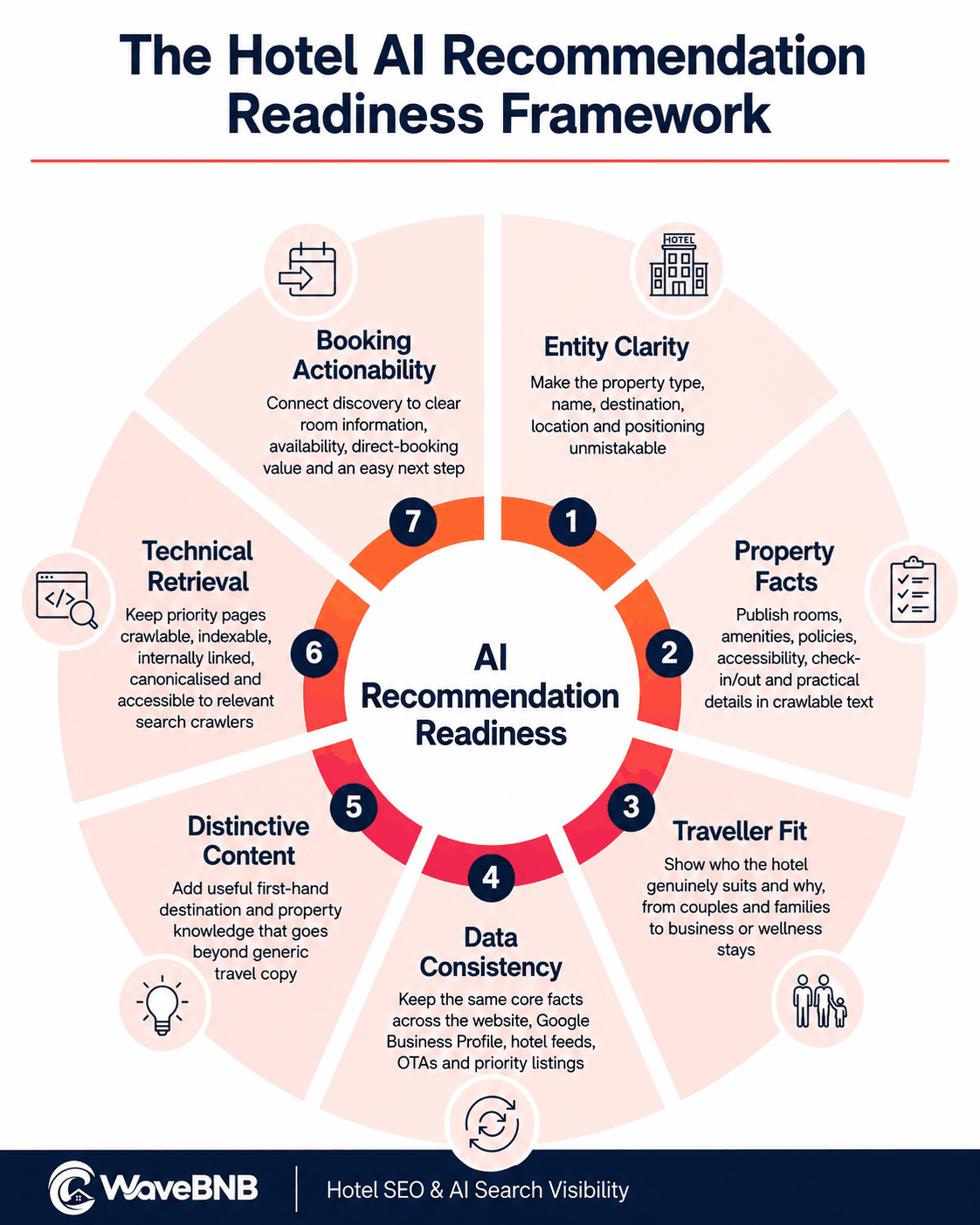
A useful hotel AI-search audit can be organised around seven signals. None is a guaranteed ranking factor across every engine. Together, however, they remove the most common reasons a system may struggle to understand or confidently surface a property.
3.1 Make the hotel entity unmistakably clear
State the property name, property type, exact destination or neighbourhood, address, contact details and defining positioning consistently. Avoid vague homepage language that makes the hotel sound interchangeable with every competitor. A machine should be able to distinguish whether you are a boutique city hotel, adults-only resort, aparthotel, family resort, historic inn or luxury wellness property within seconds of parsing the page.
3.2 Publish the factual property information travellers actually compare
Create clear, textual information for room types, occupancy, beds, views, accessibility, parking, pet policy, breakfast, Wi-Fi, pool, spa, check-in and check-out, transport, family facilities, dining and other important decision factors. If a critical fact only exists inside an image, PDF, third-party booking widget or staff member’s head, you are making it harder for both search systems and guests to use.
3.3 Define who the property is genuinely a good fit for
AI recommendations are often framed around use cases rather than generic category terms. Make legitimate fit explicit: couples, families, business travellers, remote workers, hikers, beach trips, weddings, wellness stays, accessible travel or short city breaks. The goal is not to claim suitability for everyone. It is to make genuine strengths specific and verifiable.
3.4 Keep your public hotel facts consistent
Google’s hotel documentation shows that hotel information can be assembled from multiple sources. That makes contradiction expensive. Check the website, Google Business Profile, hotel feeds, major OTAs, maps listings, directories and review platforms for mismatched names, amenities, policies, contact details and location descriptions. Consistency does not guarantee a recommendation, but inconsistency gives retrieval systems more uncertainty to resolve.
3.5 Create distinctive first-party content
Google’s 2026 generative AI guidance emphasises unique, useful, non-commodity content. For a hotel, this means first-hand destination knowledge, original neighbourhood guidance, genuinely useful room comparisons, local itineraries, accessibility detail, event advice, transport guidance and staff expertise. A generic “10 things to do in Paris” article adds less value than “A walkable 48-hour itinerary from our hotel in Le Marais, with timings and rainy-day alternatives”.
3.6 Make the site technically easy to retrieve
Important pages should return normal crawlable HTML, be internally linked, canonicalised correctly, included in XML sitemaps and free from accidental noindex, robots.txt or CDN/WAF blocks. Important facts should be available in text. Heavy JavaScript, duplicate location pages, orphaned room pages and booking flows that hide all useful information behind scripts can reduce discoverability.
3.7 Give the recommendation somewhere useful to go
AI visibility has limited commercial value if the traveller lands on a slow page, cannot see room differences, or has to restart the search to find availability. Connect informational discovery to a strong property page, room page, offer or booking engine. Make direct booking benefits clear without hiding basic facts behind a conversion wall.
4. How to optimise the pages that AI systems need most
Not every hotel needs hundreds of SEO pages. Most properties will get more value from making a smaller set of commercially important pages substantially clearer and more complete.
| Page type | What it should make clear | AI-search value |
|---|---|---|
| Homepage / property page | Property type, destination, positioning, signature features, key audience fit, proof and direct path to rooms or booking. | Defines the core entity and proposition. |
| Room and suite pages | Room name, occupancy, beds, size, views, amenities, accessibility, images and who each room suits. | Supports detailed comparison and fit questions. |
| Facilities / amenities | Parking, pool, spa, gym, dining, breakfast, Wi-Fi, pets, family facilities and any conditions or charges. | Answers high-intent attribute queries. |
| Location / destination | Exact area, landmark distances, transport, walkability, local context and first-hand recommendations. | Connects the hotel to destination and itinerary intent. |
| Offers / packages | Eligibility, dates, inclusions, exclusions and booking conditions in crawlable text. | Makes promotional information understandable and current. |
| Policies / practical information | Check-in/out, cancellation context, accessibility, parking, pets, children, payments and contact routes. | Reduces ambiguity around booking decisions. |
| About / contact | Ownership or brand story, address, contact details and consistent organisation information. | Reinforces entity clarity and trust. |
5. How to write for conversational hotel searches without creating thin content
Conversational search is more specific than a traditional two-word hotel keyword, but the wrong response is to create a new page for every possible sentence a traveller could type. Google explicitly warns against scaled content created mainly to manipulate generative search and says exact phrase matching is not required for its systems to understand relevance.
Instead, organise content around durable traveller decision themes. One strong family-stay page can answer cot availability, connecting rooms, breakfast, pool supervision, nearby attractions, pushchair access and family dining without producing seven near-duplicate pages. One destination hub can support multiple related questions through useful sub-sections and internal links.
Use natural question-shaped headings where they help the reader, concise direct answers near the top of relevant sections, comparison tables where room choice is genuinely complex, and specific evidence instead of broad superlatives. “Seven minutes’ walk from Central Station” is easier to evaluate than “perfectly located”. “Secure on-site parking is available for £18 per night” is more useful than “convenient parking options”.
6. Technical SEO and crawler access for AI search
Before changing content, make sure the hotel’s priority pages are actually retrievable. For Google’s AI features, pages need to be indexed and eligible to appear in normal Search with a snippet. Google also recommends normal crawling best practices, sensible internal linking, text availability and a good page experience.
For ChatGPT Search, OpenAI says sites should allow OAI-SearchBot and ensure the host or CDN permits traffic from OpenAI’s published searchbot IP addresses. This is separate from GPTBot, which relates to model training. A hotel can therefore make an intentional choice about search visibility without assuming every OpenAI crawler serves the same purpose.
- Check robots.txt for accidental blocking of Googlebot, Bingbot and OAI-SearchBot where you want those systems to access public pages.
- Check CDN, WAF and bot-protection rules for 403 responses or JavaScript challenges that block legitimate crawlers.
- Confirm canonical tags point to the preferred live hotel URL, especially where booking or campaign parameters generate duplicates.
- Keep XML sitemaps clean and submit them to Google Search Console and Bing Webmaster Tools.
- Use internal links from the homepage and destination hubs to rooms, facilities, offers and practical-information pages.
- Keep important hotel facts in crawlable HTML rather than relying only on image text, pop-ups or embedded booking-engine content.
7. Structured data for hotels: what it can and cannot do
Structured data helps search systems interpret explicitly labelled information, but it should describe what the visitor can already see. Google says structured data used for its search features should match visible page content, and its AI documentation is clear that there is no special AI-only schema required for AI Overviews or AI Mode.
For hotel websites, Schema.org provides Hotel and broader LodgingBusiness types, plus accommodation types such as HotelRoom. Relevant properties can describe amenities, check-in and check-out times, number of rooms, pet policy and other factual information. Room and offer modelling can become more complex, so implementation should match the site architecture and booking setup rather than copying a generic JSON-LD block.
- Use Hotel when the entity is clearly a hotel; use the appropriate lodging subtype or LodgingBusiness where it better matches the property.
- Keep name, URL, address, telephone, images and other core entity information accurate.
- Use amenityFeature, checkinTime, checkoutTime and other relevant properties only when they reflect visible, current information.
- Model room types carefully where the site has dedicated room pages and reliable room facts.
- Validate markup and fix contradictions between schema and on-page copy.
- Do not add invented reviews, ratings, facilities, offers or “AI optimisation” properties that do not exist in the vocabulary.
One 2026 update is worth noting: Google stopped showing FAQ rich results from 7 May 2026. Hotels can still use well-written question-and-answer content because it helps visitors and can make information easier to extract, but FAQPage markup should not be treated as a current Google rich-result tactic.
8. Reviews, listings and third-party corroboration
A hotel rarely exists online through its own website alone. Google’s hotel help pages state that hotel amenities and other details can come from multiple sources, while review and travel platforms independently describe the property. From an AI-search perspective, this makes third-party consistency important even when an engine does not disclose exactly how each source is weighted.
Audit the information that high-visibility third parties publish about the property. Correct outdated amenity claims, duplicate listings, old names, wrong map pins, stale phone numbers and policy changes. Encourage genuine reviews through normal guest-experience processes, but do not manufacture reviews or create artificial mentions simply to influence AI outputs.
The strongest external evidence is useful because it is real: destination press, tourism-board listings, reputable local guides, awards you have genuinely earned, partnerships, event pages, wedding directories where relevant, and detailed guest reviews that independently reinforce what the hotel actually offers.
9. What not to do for AI search optimisation
AI search has created a new layer of marketing terminology, but not every new tactic deserves budget. Google’s 2026 guidance specifically says site owners can ignore tactics such as unnecessary AI text files like llms.txt, content “chunking” done as a supposed AI hack, and inauthentic mentions.
- Do not publish dozens of near-identical pages for every prompt variation.
- Do not buy fake citations, forum mentions or reviews to manufacture “AI authority”.
- Do not assume an llms.txt file will make Google AI Mode cite the hotel more often.
- Do not replace important property facts with vague lifestyle copy just because it sounds premium.
- Do not add structured data for information that is not visible or true.
- Do not block the search crawler you expect to use your pages and then blame the content strategy.
- Do not report one favourable manual AI answer as proof of permanent ranking. Outputs can vary by prompt, location, freshness and engine.
10. How to measure hotel visibility in AI search
Traditional rank tracking is not enough because conversational answers vary. Build a small measurement system that combines platform data, analytics and controlled manual testing.
| Measurement | What to track | How to use it |
|---|---|---|
| Google Search Console generative AI report | AI-feature impressions by page, date, country and device where the report is available. | Identify which hotel pages already appear and whether visibility is growing. |
| Bing Webmaster Tools AI Performance | Citations, cited URLs and sampled grounding queries across supported AI experiences. | Find content that is being referenced and topics where clarity can improve. |
| ChatGPT referral analytics | Sessions and conversions from chatgpt.com referrals. OpenAI says referral URLs include tracking that can be measured in analytics. | Connect AI visibility to site behaviour and booking intent. |
| Manual prompt set | 10–20 repeatable traveller questions across target engines, markets and trip types. | Track whether the hotel appears, which competitors appear, what facts are cited and whether any answer is wrong. |
| Revenue / booking outcomes | Direct bookings, assisted conversions, room-page engagement and booking-engine starts from AI referral sessions where measurable. | Keep the programme commercially accountable rather than optimising for mentions alone. |
Google’s generative AI performance reporting is still rolling out, so not every Search Console property will see it. Where platform-level reporting is incomplete, keep a dated baseline and focus on trends rather than pretending AI recommendation can be reduced to one fixed rank.
11. A 30-day hotel AI-search implementation plan
| Week | Priority | Actions | Output |
|---|---|---|---|
| Week 1 | Baseline and access | Audit indexation, robots.txt, OAI-SearchBot access, XML sitemaps, canonicalisation, Business Profile, major OTA facts and a 10–20 prompt benchmark. | AI visibility baseline + technical issue list. |
| Week 2 | Property facts and entity clarity | Rewrite weak property, room, amenities, location and policy information. Correct inconsistent facts across priority listings. | One reliable property information layer. |
| Week 3 | Content and structured data | Add useful traveller-fit content, room comparisons, destination guidance and valid Hotel/LodgingBusiness markup that matches visible facts. | Stronger first-party evidence + structured entity data. |
| Week 4 | Measurement and iteration | Review Search Console/Bing data where available, ChatGPT referrals and the manual prompt set. Fix incorrect AI facts and prioritise content gaps that correspond to genuine guest needs. | Monthly AI-search scorecard and next sprint. |
Frequently asked questions
Can a hotel guarantee that ChatGPT or Google AI will recommend it?
No. OpenAI says placement is not guaranteed, and Google says crawling, indexing and serving are not guaranteed even when a page follows requirements. Optimisation improves eligibility, clarity and evidence. It does not create a guaranteed recommendation slot.
Is hotel AI search optimisation different from hotel SEO?
It is best treated as an extension of hotel SEO rather than a replacement. Technical accessibility, internal linking, useful content, local information, authority and page experience still matter. AI search adds more emphasis on extractable facts, conversational intent, entity consistency and citation visibility.
Do hotels need llms.txt?
Not for Google AI Overviews or AI Mode. Google’s current guidance says there is no need to create new AI text files or special machine-readable files for those features. Other technologies may evolve, but it should not be treated as a universal AI-search requirement.
Does schema make a hotel more likely to be recommended?
Schema can make factual information easier to interpret and can support search features where eligible, but it is not a recommendation guarantee. Use it to describe accurate visible information, not as a substitute for content, reviews, listings or technical SEO.
Should a hotel create an FAQ section for AI search?
Only where guests genuinely need those answers. Clear Q&A content can be useful to travellers and extractable by search systems. However, Google discontinued FAQ rich results in May 2026, so the business case should be usefulness and clarity, not FAQ rich-result eligibility.
How often should we test AI visibility?
Monthly is a practical starting cadence for most independent hotels, with additional checks after major site, positioning, amenity or listing changes. Use the same core prompt set so you can distinguish genuine progress from random answer variation.
Turn AI visibility into direct-booking demand
The hotels most likely to benefit from AI search are not the ones chasing the most new acronyms. They are the ones that make their proposition unusually easy to understand, back it with accurate and current information, publish first-hand content travellers can actually use, and connect discovery to a strong direct-booking experience.
Start by removing ambiguity. Make sure an AI system and a human visitor can answer the same questions from your website: what the property is, where it is, who it suits, what each room offers, what is included, which policies matter, why the location is useful, and how to book.
Next steps
Book a Growth Audit
Want to understand where your hotel is losing visibility across search, AI discovery and the direct-booking journey? Book a WaveBNB Growth Audit to review your current visibility, content, technical SEO and conversion path, then prioritise the changes most likely to generate qualified direct demand.
Explore Hotel SEO & Visibility
Explore WaveBNB Hotel SEO & Visibility to see the approach to search visibility across Google Search, Maps and AI discovery.