




Estimated reading time: 19 minutes
Publishing more content can feel like progress, but it can also hide a weaker problem. If Google cannot consistently crawl the hotel website, core pages compete with one another, local information is incomplete, or booking-intent tracking is broken, another ten articles will not repair the foundation. They can simply add more URLs to an already unclear system.
This hotel SEO audit checklist is designed for independent and boutique hotels that want to know whether the site is genuinely ready for more content. It covers 30 checks across crawlability, indexation, duplication, architecture, page experience, commercial hotel pages, content quality, local visibility, structured data, AI-search readiness and measurement. The objective is not to chase a perfect technical score. It is to remove issues that prevent qualified travellers from discovering the property and moving towards a direct booking.
What should a hotel SEO audit check before publishing more content?
Direct answer
Before publishing more hotel content, confirm that priority pages are crawlable and indexable, canonical signals are consistent, redirects and broken URLs are controlled, commercial pages have clear search intent, internal links support the site structure, Google Business Profile data is accurate, structured data matches visible content, and organic traffic can be measured through to booking intent. If a critical issue fails, fix the foundation before scaling the content calendar.
| By | Daniel Rey Founder & Hospitality Growth Strategist, WaveBNB |
| Last updated | August 2026 |
| Experience | 9+ years in growth marketing, demand generation, SEO, paid acquisition, CRO, analytics and digital strategy across B2B SaaS, technology and hospitality. Experience managing multi-channel advertising budgets of up to £200k per month. |
| Editorial note | Content is reviewed and updated as search platforms, AI discovery, advertising systems, hospitality technology and digital marketing best practices evolve. |
| Sources | Google Search Essentials | Google generative AI guidance | Google local ranking guidance | Google hotel details guidance |
About the author
Daniel Rey is the Hospitality Growth Strategist at WaveBNB, specialising in helping independent hotels, boutique properties, resorts, vacation-rental operators and property management companies improve visibility, generate more profitable direct demand and convert more travellers into guests.
Daniel brings 9+ years of experience across growth marketing, demand generation and digital strategy, with expertise spanning SEO, Google Ads, paid social, CRO, lifecycle marketing, analytics, content strategy and AI automation. He has managed multi-channel advertising budgets of up to £200k per month and built acquisition and conversion programmes focused on measurable commercial outcomes rather than vanity metrics.
Through WaveBNB, his work focuses on the complete hospitality growth journey, from hotel SEO and AI-search visibility through paid acquisition, direct-booking conversion, analytics and AI-powered guest experiences. His approach connects visibility, qualified traffic and booking intent to direct revenue, conversion efficiency and sustainable hospitality growth.
Key takeaways
- Do not treat an SEO audit as a long list of minor warnings. Separate critical blockers from improvements that can be fixed while content continues.
- A hotel should resolve crawl, indexation, canonical and page-ownership problems before expanding the number of URLs targeting similar guest searches.
- The highest-value pages are usually the homepage, rooms and suites, offers, location, amenities, experiences and other pages closest to booking intent. Audit those before judging the blog.
- Google Business Profile is part of hotel SEO. Profile accuracy, hotel details, photos, reviews and on-site location signals should agree.
- AI-search visibility still depends on strong SEO foundations. Google states that existing technical SEO requirements remain relevant for its generative AI search features, without requiring special AI schema.
- A hotel SEO audit is commercially incomplete if it stops at rankings. Search Console, analytics and booking-engine tracking should connect visibility to qualified sessions and booking actions.
Table of contents
- What should a hotel SEO audit check before publishing more content?
- Why audit before publishing more content?
- How to use this 30-check hotel SEO audit checklist
- The 30-check hotel SEO audit checklist at a glance
- Checks 1-5: crawlability and indexation
- Checks 6-9: canonicals, duplicate URLs and redirects
- Checks 10-13: site architecture and internal linking
- Checks 14-17: page experience, rendering and the booking journey
- Checks 18-22: on-page SEO for commercial hotel pages
- Checks 23-25: content quality, cannibalisation and trust
- Checks 26-28: local hotel SEO and Google Business Profile
- Checks 29-30: structured data, AI discovery and measurement
- How to prioritise the findings: stop, fix or publish
- Frequently asked questions
- Fix the SEO foundation before scaling the content calendar
- Next steps: audit your hotel SEO foundation
Why audit before publishing more content?
Content works best when every new page has a clear owner, a useful role in the guest journey and a technically sound path into search. An audit protects that system. It shows whether a hotel needs more pages, stronger existing pages, technical repairs, better local information or better measurement before the next content sprint begins.
The distinction matters because publishing volume is not the same as search progress. A destination guide can attract impressions while the room pages remain weak. A new offer page can compete with an older offer page. A technically polished article can still be commercially useless if it has no internal path to rooms, availability or another relevant next action.
COMMERCIAL PRINCIPLE
Audit the path from discovery to booking intent, not just the blog folder. The right question is not “How many SEO issues does the site have?” It is “Which issues are stopping relevant travellers from finding, understanding and acting on the hotel’s best pages?”
Sources: Google Search Essentials | Google Search technical requirements
How to use this 30-check hotel SEO audit checklist
Run the checks against the live site, not a staging copy, and prioritise the templates and URLs that matter most commercially. For an independent hotel, that usually means the homepage, room and suite pages, offers, location and directions, major amenities, experiences, events or wedding pages where relevant, and the booking handoff.
Mark each check as Pass, Fix or Critical. “Pass” does not mean technically perfect. It means the issue is not materially blocking discovery, clarity or booking intent. “Fix” means the issue should enter the roadmap. “Critical” means it can undermine the value of publishing more content and should normally be resolved first.
- Critical: crawl or indexation blockers, severe canonical conflicts, broken commercial templates, widespread accidental noindex rules, unresolved page ownership or measurement gaps that make commercial impact invisible.
- Fix: internal-link weaknesses, duplicated titles, incomplete hotel details, thin existing pages, underperforming Core Web Vitals or unclear page intent.
- Pass: the control is technically sound and commercially fit for purpose. Keep monitoring it rather than redesigning it for the sake of an audit score.
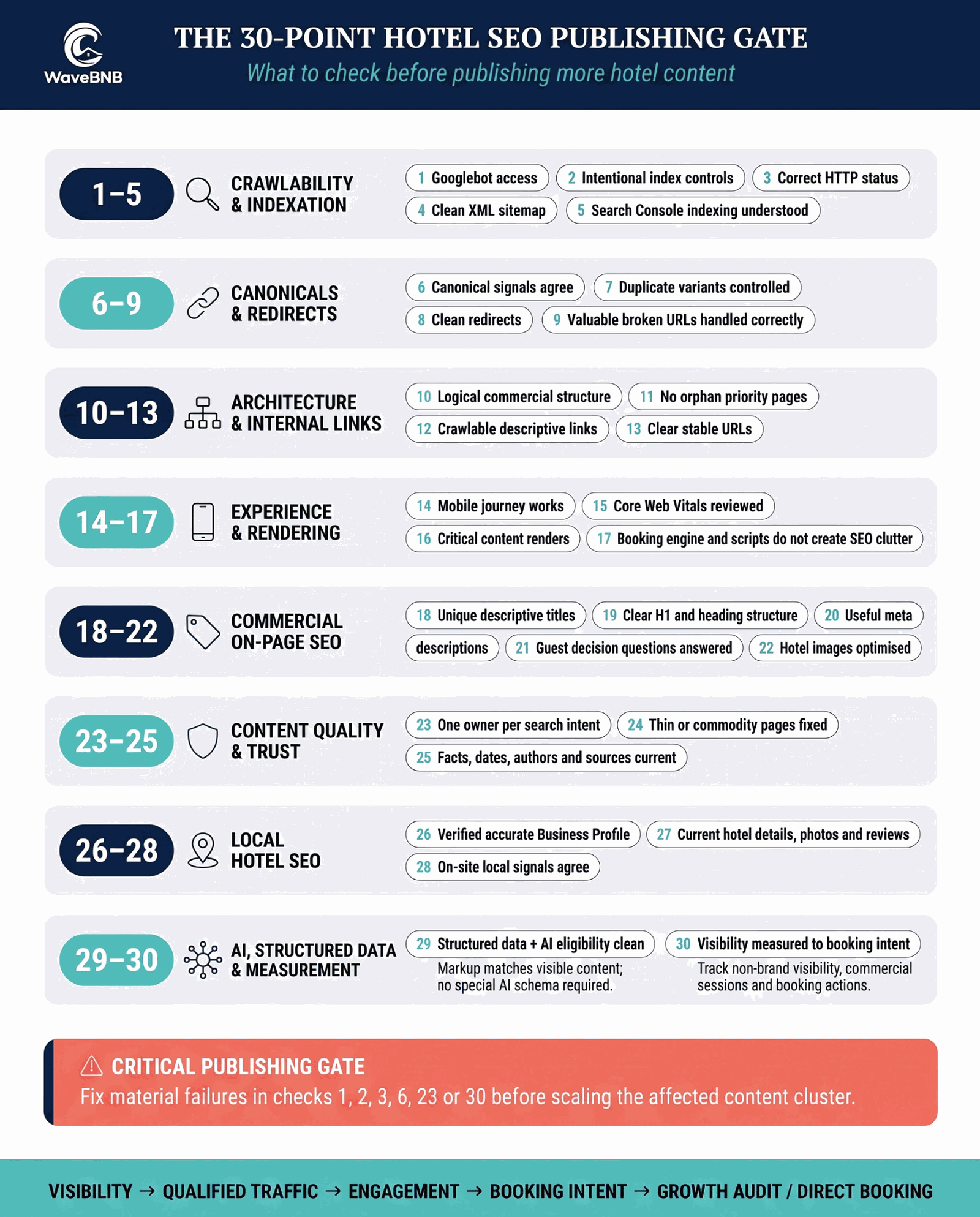
The 30-check hotel SEO audit checklist at a glance
| # | Audit check | Pass signal | Priority |
|---|---|---|---|
| 1 | Googlebot can access priority hotel pages | Important URLs are publicly accessible and crawlable. | Critical |
| 2 | Index directives are intentional | No accidental noindex or conflicting index controls on valuable pages. | Critical |
| 3 | Priority URLs return the correct status | Commercial pages return 200; errors are intentional and understood. | Critical |
| 4 | The XML sitemap contains preferred URLs | Only canonical, indexable URLs that matter are included. | High |
| 5 | Search Console indexing issues are understood | Excluded and indexed URLs make sense for the site. | High |
| 6 | Canonical signals agree | Canonical tags, redirects, internal links and sitemap choices point to the same preferred URLs. | Critical |
| 7 | Duplicate URL variants are controlled | Protocol, hostname, parameters and duplicate paths do not create competing versions. | High |
| 8 | Redirects are clean | No loops or unnecessary chains on important hotel URLs. | High |
| 9 | Valuable broken URLs are handled correctly | Useful legacy URLs are redirected; truly removed pages can remain 404/410. | High |
| 10 | Priority pages sit in a logical architecture | Rooms, offers, location and other commercial pages are easy to reach. | High |
| 11 | There are no orphan priority pages | Every page that matters has at least one crawlable internal link. | High |
| 12 | Internal links are crawlable and descriptive | HTML links use relevant anchor text and support page relationships. | High |
| 13 | URLs are clear and stable | Slugs are readable, consistent and not changed without a reason. | Medium |
| 14 | The mobile experience works | Navigation, content and booking actions are usable on a real phone. | High |
| 15 | Core Web Vitals are acceptable on priority templates | Performance problems are diagnosed on real hotel page templates. | High |
| 16 | Important content renders for search engines | Critical text and links are present in rendered HTML and not lost to JavaScript failures. | High |
| 17 | The booking engine and third-party scripts do not create SEO clutter | The booking handoff works and does not generate uncontrolled indexable duplicates. | High |
| 18 | Page titles are unique and descriptive | Each important page has a concise title aligned to its primary intent. | High |
| 19 | H1 and heading structure reflect the page intent | One clear main purpose is reinforced by useful supporting headings. | High |
| 20 | Meta descriptions are page-specific and useful | Critical pages have accurate summaries instead of duplicate keyword lists. | Medium |
| 21 | Commercial pages answer guest decision questions | Rooms, location and offers reduce uncertainty and show a clear next action. | High |
| 22 | Hotel images are useful and optimised | Images support guest decisions, are appropriately compressed and use descriptive alt text where informative. | Medium |
| 23 | Keyword and page ownership prevent cannibalisation | Each valuable intent has one canonical owner; overlap is merged, differentiated or retired. | Critical |
| 24 | Thin or commodity pages are improved, merged or removed | Templated or near-duplicate pages do not multiply low-value content. | High |
| 25 | Facts, dates, authors and sources are current | Editorial and operational information is maintained and attributable. | High |
| 26 | The hotel Business Profile is verified and accurate | Name, address, phone, website and category are correct. | High |
| 27 | Hotel details, photos and reviews are current | Amenities, attributes, imagery and review responses are maintained. | High |
| 28 | On-site local signals agree with the profile | Website identity, directions and local context are consistent with the profile. | High |
| 29 | Structured data and AI-search eligibility are clean | Markup matches visible content; normal Search eligibility is intact; no special AI schema is assumed. | High |
| 30 | Organic visibility can be measured through to booking intent | Non-brand visibility, commercial sessions and at least one booking-intent action have a reliable baseline. | Critical |
Checks 1-5: crawlability and indexation
Check 1: Googlebot can access priority hotel pages. Google’s minimum technical requirements start with access. Test the homepage, room pages, offers, location pages and other commercially valuable URLs in Search Console. They should be publicly accessible to Googlebot and not accidentally blocked by robots.txt, authentication, a staging rule, a CDN firewall or another access control.
Check 2: index directives are intentional. Review meta robots tags and HTTP headers on important pages. A noindex directive can keep a page out of Google Search, but Google must be able to crawl the URL to see it. Do not use robots.txt as a substitute for a noindex rule. Pay particular attention after redesigns, migrations, staging launches and changes to SEO plugins.
Check 3: priority URLs return the correct status. Important commercial pages should normally return an HTTP 200 response. Error pages, soft errors and misconfigured redirects can stop important content being indexed or make the site harder to diagnose. Check expired offers, retired room types and campaign URLs as well as core evergreen pages.
Check 4: the XML sitemap contains preferred URLs. The sitemap should list the canonical, indexable URLs that the hotel actually wants surfaced. Remove URLs that redirect, are noindexed, duplicate another preferred page or exist only because of a parameter. Submitting a sitemap can help discovery and communicate preferred URLs, but it is not an indexing guarantee.
Check 5: Search Console indexing issues are understood. Do not chase every excluded URL. Decide whether exclusions are intentional. Filter, booking, archive and parameter URLs may be correctly excluded. A valuable room or offer page may not be. Review Page Indexing and URL Inspection data against the site’s actual commercial architecture.
Sources: Google Search technical requirements | Block Search indexing with noindex | Build and submit a sitemap
Checks 6-9: canonicals, duplicate URLs and redirects
Check 6: canonical signals agree. Canonical tags, redirects, internal links and sitemap choices should reinforce the same preferred URL. Conflicting signals make the preferred version less clear. This matters on hotel sites where tracking parameters, language paths, campaign URLs and booking-engine links can generate multiple versions of similar content.
Check 7: duplicate URL variants are controlled. Check HTTP versus HTTPS, www versus non-www, trailing-slash conventions, tracking parameters, filter URLs, print versions and booking-engine parameters. Duplicate content is normal on the web, but uncontrolled variants can waste crawl attention, complicate reporting and blur page ownership.
Check 8: redirects are clean. A redirect should normally take users and crawlers to the most relevant final destination in as few steps as practical. Audit recent migrations, renamed rooms, expired offers and campaign URLs for loops, chains and redirects to unrelated pages.
Check 9: valuable broken URLs are handled correctly. Do not automatically redirect every 404 to the homepage. If a retired page has a strong replacement, redirect it there. If the content is genuinely gone with no relevant substitute, a 404 or 410 can be appropriate. Focus first on broken URLs that still receive links, impressions or traffic.
Sources: Canonicalization and duplicate URLs | SEO Starter Guide
Checks 10-13: site architecture and internal linking
Check 10: priority pages sit in a logical architecture. A guest and a crawler should be able to reach rooms, offers, location, amenities and other major decision pages without hunting through the blog. The structure should reflect how travellers evaluate the property, not the order in which pages happened to be created.
Check 11: there are no orphan priority pages. Every page you care about should receive at least one internal link from another relevant page. This is particularly important for seasonal offers, new room types, venue pages and high-value destination content that can otherwise sit outside the main navigation.
Check 12: internal links are crawlable and descriptive. Use normal HTML links with href attributes and anchor text that tells the reader what to expect. “Explore our spa packages” is more useful than a generic “click here”. Internal links should also move readers from research content towards the next relevant commercial page.
Check 13: URLs are clear and stable. Readable slugs help teams understand page purpose and reduce the temptation to create duplicate alternatives. Do not rename established URLs just to insert an extra keyword. Change a live URL only when the structural benefit justifies the redirect and migration work.
Sources: Google link best practices
Checks 14-17: page experience, rendering and the booking journey
Check 14: the mobile experience works. Open the core guest journey on a real phone. Check navigation, room galleries, offer details, pop-ups, sticky elements, forms and the transition into the booking engine. Mobile usability is a guest-conversion issue as much as an SEO issue.
Check 15: Core Web Vitals are acceptable on priority templates. Use Search Console and page-level diagnostics to identify recurring template problems. Google’s current good thresholds are LCP within 2.5 seconds, INP below 200 milliseconds and CLS below 0.1. Treat these as user-experience targets, not a guarantee of higher rankings.
Check 16: important content renders for search engines. If the hotel uses heavy JavaScript, confirm that room descriptions, offer terms, headings and internal links are present in the rendered page that Google sees. Critical content should not depend on a script that fails, requires interaction or only paints text visually without making it accessible in the document structure.
Check 17: the booking engine and third-party scripts do not create SEO clutter. A third-party booking engine may sit on another domain, subdomain or embedded flow. Audit the handoff for broken links, duplicate parameter URLs, crawl traps, slow scripts and analytics gaps. The aim is a clean public website plus a reliable booking path, not to force the booking engine itself to rank for every search.
Sources: Understanding Core Web Vitals | Google Search technical requirements
Checks 18-22: on-page SEO for commercial hotel pages
Check 18: page titles are unique and descriptive. Every critical page should have a concise title that makes its purpose clear. Avoid repeating the same generic hotel name across room pages or stuffing city keywords into every title. Google can build title links from several page signals, so the visible H1, page title and surrounding content should tell a consistent story.
Check 19: H1 and heading structure reflect the page intent. The main heading should make the page purpose obvious, while supporting headings organise the information a guest needs. Do not create multiple visually competing main headings just to place more keywords on the page.
Check 20: meta descriptions are page-specific and useful. Google primarily creates snippets from page content and may use the meta description when it better describes the page. Write accurate summaries for the homepage and high-value commercial pages. Avoid long keyword lists or identical descriptions copied across the site.
Check 21: commercial pages answer guest decision questions. A room page should explain the room, occupancy, bed configuration, views, relevant amenities and booking considerations. A location page should help a traveller understand access and context. An offer page should explain eligibility, inclusions and next steps. SEO copy should reduce uncertainty rather than pad the page.
Check 22: hotel images are useful and optimised. Use high-quality images that genuinely help travellers evaluate the property, compress them appropriately, and add descriptive alt text where the image conveys information. Decorative images do not need keyword-heavy alt text. Image filenames and surrounding copy should be clear enough for a content team to manage consistently.
Sources: Influencing title links in Google Search | Control your snippets in search results | Google Search Essentials
Checks 23-25: content quality, cannibalisation and trust
Check 23: keyword and page ownership prevent cannibalisation. Map each important search intent to one canonical page. If two pages target the same topic, same search intent and same hotel buyer, decide whether to merge them, differentiate them or retire one. This check should happen before approving another article brief.
Check 24: thin or commodity pages are improved, merged or removed. More pages do not create authority by themselves. Review templated destination pages, near-duplicate amenity pages and scaled content that adds little beyond information already available elsewhere. Google’s 2026 guidance for generative AI search emphasises valuable, unique, non-commodity content rather than mass-producing every query variation.
Check 25: facts, dates, authors and sources are current. Important guides should make it clear who created or reviewed the content, when it was updated and where external claims come from. For hotel information, operational facts such as amenities, policies, distances, opening times and inclusions should be checked whenever the property changes.
Sources: Optimizing for generative AI features on Google Search | Google Search Essentials | Latest Google Search documentation updates
Checks 26-28: local hotel SEO and Google Business Profile
Check 26: the hotel Business Profile is verified and accurate. Confirm the hotel name, address, phone number, website and most appropriate category. Google states that complete and accurate business information improves the chance of matching relevant local searches. Local ranking is mainly based on relevance, distance and prominence, so accuracy matters even when distance cannot be influenced.
Check 27: hotel details, photos and reviews are current. Review amenities and attributes in the hotel profile, remove clearly outdated imagery where possible, add current photos, and maintain a review-response process. Google provides hotel-specific detail fields and notes that verified hotels can edit services and amenities in the Hotel details section.
Check 28: on-site local signals agree with the profile. The website should reinforce the same property identity through contact details, directions, neighbourhood context, parking or transport information and relevant destination relationships. Consistency reduces confusion for guests and gives search systems clearer context around the hotel entity and location.
Sources: Tips to improve your local ranking on Google | Manage your hotel’s details
Checks 29-30: structured data, AI discovery and measurement
Check 29: structured data and AI-search eligibility are clean. Validate structured data and make sure it describes content that users can actually see. Do not add schema simply because a plugin offers it. For Google’s generative Search features, normal Search foundations continue to apply: the page must be crawlable, indexed and eligible for Search. Google says there is no special AI schema or extra machine-readable file required. If the Generative AI performance report is available in your Search Console property, use it as an additional visibility view rather than a replacement for normal search and conversion reporting.
Check 30: organic visibility can be measured through to booking intent. Before adding more content, establish a baseline. At minimum, record non-brand impressions and clicks in Search Console, organic sessions to commercial pages in analytics, and booking-intent actions such as availability clicks or booking-engine starts. Where cross-domain and booking-engine attribution are reliable, add completed direct bookings and revenue. If revenue attribution is not reliable, do not invent precision. Improve the tracking and report the strongest observable step in the journey.
Sources: General structured data guidelines | Google generative AI optimisation guide | Search Console Generative AI performance report
How to prioritise the findings: stop, fix or publish
A useful audit ends with decisions, not a spreadsheet full of warnings. Prioritise findings by commercial impact and dependency: issues that stop crawling, indexation, page ownership or booking measurement come before cosmetic improvements.
| Decision | Use when | Typical examples | Content action |
|---|---|---|---|
| STOP AND FIX FIRST | A failure can prevent important pages being crawled, indexed or understood correctly. | Accidental noindex, blocked core pages, severe canonical conflicts, broken priority templates, unresolved cannibalisation. | Pause scaling on the affected cluster until the blocker is corrected. |
| FIX IN PARALLEL | The site is fundamentally indexable but has quality, architecture, local or performance weaknesses. | Weak internal links, incomplete hotel details, duplicate titles, slower templates, thin existing pages. | Continue only with briefs that have clear page ownership and do not worsen the issue. |
| PUBLISH AND SCALE | Critical controls pass and the content system has a defined commercial purpose. | Clear page owners, crawlable architecture, accurate local data, reliable baseline tracking. | Publish content that strengthens a parent commercial page and a measurable guest journey. |
For most independent hotels, the highest-return outcome is not “30 out of 30”. It is a short, ordered backlog that protects the commercial pages first, clarifies what content should exist next and creates a baseline against which the next 90 days can be measured.
Frequently asked questions
What is a hotel SEO audit?
A hotel SEO audit is a structured review of whether a property website can be crawled, indexed, understood and trusted by search engines, and whether its key pages are aligned to traveller intent. A useful audit also reviews local visibility and the path from organic traffic to booking intent.
What should a hotel SEO audit include?
A hotel SEO audit should cover crawlability, indexation, canonical control, redirects, architecture, internal linking, mobile experience, performance, commercial on-page SEO, content quality, Google Business Profile, structured data and measurement. The audit should prioritise issues by their effect on commercially important pages and booking intent.
How often should a hotel run an SEO audit?
Run a focused audit after major website, booking-engine or CMS changes, and use lighter checks continuously through Search Console and analytics. A broader review every quarter or two can be sensible for an active hotel website, but the right cadence depends on how frequently the site changes.
Should a hotel stop publishing content until every SEO issue is fixed?
No. Stop scaling only when the audit finds critical blockers or unresolved page ownership. Minor metadata, performance or local-profile improvements can often be fixed in parallel. The objective is to prevent new content from multiplying existing structural problems.
Which hotel pages should be audited first?
Start with the homepage and pages closest to a booking decision: rooms and suites, offers, location, amenities, experiences, weddings or events where relevant, and the booking handoff. Then audit the content cluster that supports those pages.
Does a hotel need separate optimisation for AI search?
Not as a separate technical layer for Google Search. Google says normal SEO fundamentals remain relevant for its generative AI features, including crawlability, indexability, internal links, page experience, useful textual content and structured data that matches what users can see.
Fix the SEO foundation before scaling the content calendar
Before approving the next batch of hotel content, run these 30 checks against the live website and turn the findings into one ordered backlog. Fix critical crawl, indexation, canonical and page-ownership issues first. Then strengthen commercial hotel pages and local signals. Only after the foundation is clear should the content calendar accelerate.
Next steps: audit your hotel SEO foundation
Book a Growth Audit
If you want an external view of what is limiting qualified visibility, WaveBNB can review the hotel’s presence across Google Search, Google Maps and AI discovery, then connect the findings to commercial pages, booking intent and the next highest-value actions.
Explore Hotel SEO & Visibility
Explore Hotel SEO & Visibility to see how WaveBNB approaches search visibility across Google, Maps and AI discovery.
Read the 90-Day Hotel SEO Strategy
Read the 90-Day Hotel SEO Strategy for a practical sequence for turning audit findings into a prioritised 90-day roadmap.