


Estimated reading time: 19 minutes
Choosing a marketing agency for a hotel is not simply a question of who can run SEO, paid media or social campaigns. A hotel sells time-sensitive room inventory through a mix of direct and third-party channels, competes with OTAs in search, relies on local and map visibility, and often sends the final transaction into a separate booking engine. That makes the commercial and technical context unusually important.
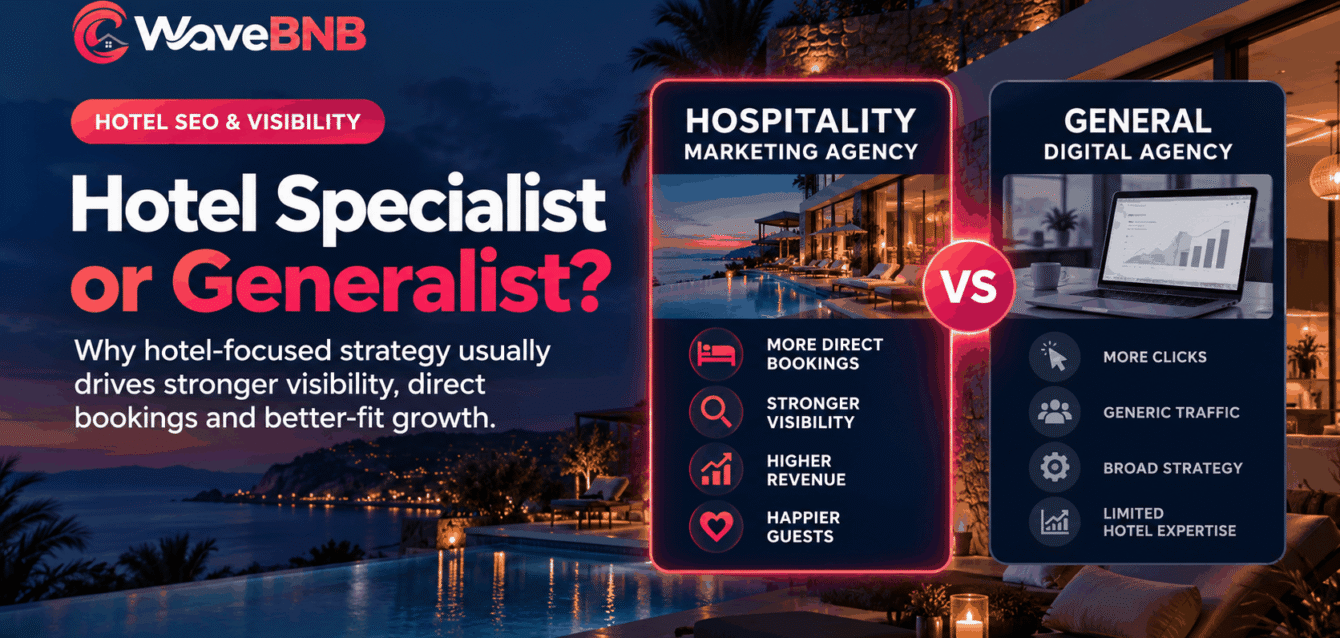
The real decision is therefore not “specialist good, generalist bad”. It is whether the agency can understand the hotel revenue model, work across the discovery and booking ecosystem, connect marketing activity to booking intent and direct revenue, and diagnose problems without months of industry briefing. This guide compares a hospitality marketing agency vs general agency model so hotel owners and commercial teams can choose the right fit for the work they actually need.
Which is better for hotels: a hospitality marketing agency or a general digital agency?
Direct answer
For most independent hotels, a hospitality-focused agency is usually the stronger choice when the remit includes hotel SEO, local search, Google hotel surfaces, booking-engine conversion or revenue attribution. A general digital agency can still be right for a narrow project or when it has proven hotel expertise. Choose the team that can demonstrate hotel fluency, define commercial KPIs and connect visibility to booking outcomes.
| By | Daniel Rey, Hospitality Growth Strategist, WaveBNB |
| Last updated | August 2026 |
| Experience | 9+ years in growth marketing, demand generation, SEO, paid acquisition, CRO, analytics and digital strategy across B2B SaaS, technology and hospitality. Experience managing multi-channel advertising budgets of up to £200k per month. |
| Editorial note | Content is reviewed and updated as search platforms, AI discovery, advertising systems, hospitality technology and digital marketing best practices evolve. |
| Sources | Based on Daniel’s professional marketing experience, WaveBNB’s hospitality growth methodology, first-party analysis and recognised industry, platform and hospitality research cited throughout this article. |
About the author
Daniel Rey is the Hospitality Growth Strategist at WaveBNB, specialising in helping independent hotels, boutique properties, resorts, vacation-rental operators and property management companies improve visibility, generate more profitable direct demand and convert more travellers into guests.
Daniel brings 9+ years of experience across growth marketing, demand generation and digital strategy, with expertise spanning SEO, Google Ads, paid social, CRO, lifecycle marketing, analytics, content strategy and AI automation. He has managed multi-channel advertising budgets of up to £200k per month and built acquisition and conversion programmes focused on measurable commercial outcomes rather than vanity metrics.
Through WaveBNB, his work focuses on the complete hospitality growth journey, from hotel SEO and AI-search visibility through paid acquisition, direct-booking conversion, analytics and AI-powered guest experiences. His approach connects visibility, qualified traffic and booking intent to direct revenue, conversion efficiency and sustainable hospitality growth.
Key takeaways
- Hospitality specialism matters most when marketing performance depends on the hotel distribution model, booking engine, local search, Hotel Center, OTAs and direct-booking attribution.
- A general digital agency can be a strong choice when the scope is genuinely narrow, or when it has a dedicated hospitality team and documented hotel capability.
- Do not choose an agency because it uses hotel vocabulary. Test whether it can explain how search visibility, booking intent, booking-engine data and direct revenue connect.
- For hotel SEO, the partner should understand Google Search, Google Business Profile, hotel-specific booking links, destination intent, branded versus non-brand demand and the commercial pages closest to a booking.
- Specialist status is not proof of quality. Relevant evidence, transparent methodology, account ownership, measurement discipline and a clear 90-day operating plan matter more than the agency label.
- The strongest selection process scores agencies against the same hotel-specific criteria before comparing price.
Table of contents
- Which is better for hotels: a hospitality marketing agency or a general digital agency?
- What a hospitality marketing agency actually does
- Hospitality marketing agency vs general agency: the core difference
- Why hotel marketing requires specialist commercial context
- When a hospitality specialist is usually the better fit
- When a general digital agency can be the better choice
- What matters more than the agency label
- Seven questions to ask before hiring any hotel marketing agency
- A practical scorecard for comparing agencies
- Red flags to avoid
- What a good first 90 days should look like
- Frequently asked questions
- Is a hospitality marketing agency always better than a general agency?
- Can a general SEO agency do hotel SEO?
- What should a hotel marketing agency measure?
- Is a specialist hotel agency worth a higher fee?
- Should a hotel use one agency or several specialists?
- What should a hospitality agency know before starting?
- Sources and further reading
- Choose the agency that can diagnose the hotel’s commercial constraint
- Next steps
What a hospitality marketing agency actually does
A hospitality marketing agency is a specialist partner that applies digital marketing to the economics and customer journey of accommodation businesses. The useful distinction is not that it offers different channels. Both a specialist and a general agency may offer SEO, content, paid media, analytics and website work. The distinction is the operating context used to decide what to do, what to measure and what to prioritise.
For a hotel, that context includes room-night inventory, direct and OTA distribution, destination and branded search, Google Maps and Business Profile, Hotel Center booking links, the booking engine, seasonality, source markets and the point at which a marketing interaction becomes a reservation. A capable hospitality agency should be able to work inside that system rather than treating the hotel as a generic local business or e-commerce account.
THE USEFUL DEFINITION A hospitality marketing agency should not be judged by whether it says “RevPAR”, “OTA” or “direct bookings” on its website. It should be judged by whether those concepts change its strategy, measurement and decisions for the property.
Hospitality marketing agency vs general agency: the core difference
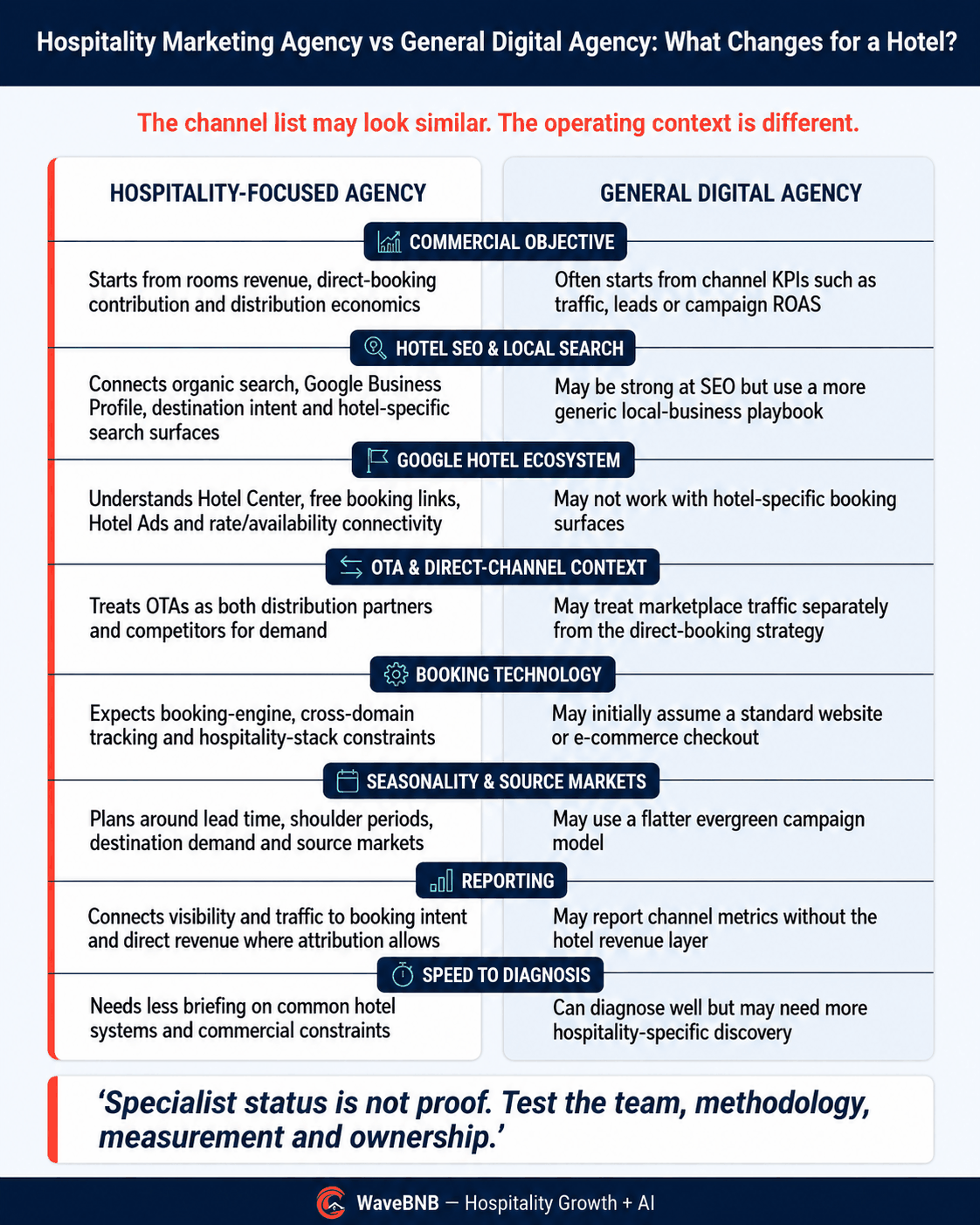
The table below shows the practical difference to test. It describes what a hospitality specialist should be able to do and where a general agency may require more briefing. It is not a guarantee that every specialist will outperform every generalist.
| Factor | Hospitality-focused agency | General digital agency | What to test |
|---|---|---|---|
| Commercial objective | Starts from rooms revenue, direct-booking contribution and distribution economics. | Often starts from channel KPIs such as traffic, leads or campaign ROAS. | Ask what single business KPI will define success. |
| Hotel SEO and local search | Connects organic search, Google Business Profile, destination intent and hotel-specific search surfaces. | May be strong at SEO but use a generic local-business playbook. | Ask for the first five hotel SEO checks they would run. |
| Google hotel ecosystem | Understands Hotel Center, free booking links, Hotel Ads and how rate/availability connectivity affects visibility. | May not touch hotel-specific booking surfaces. | Ask how your direct booking link reaches Google. |
| OTA and direct-channel context | Treats OTAs as both distribution partners and competitors for demand. | May treat marketplace traffic as separate from the direct channel. | Ask how they would reduce dependence without damaging occupancy. |
| Booking technology | Expects booking-engine and cross-domain tracking constraints and knows where PMS/CRS/channel-manager context matters. | May assume the website checkout behaves like standard e-commerce. | Ask how organic or paid traffic will be attributed through the booking engine. |
| Seasonality and source markets | Plans around lead time, shoulder periods, destination demand and geographic source markets. | May use a flatter evergreen campaign model. | Ask how budget and content priorities change by season. |
| Reporting | Should connect visibility and traffic to availability clicks, booking starts and direct revenue where attribution permits. | May report channel metrics without the hotel revenue layer. | Ask to see a sample monthly scorecard. |
| Speed to diagnosis | Needs less briefing on hospitality systems and common commercial constraints. | Can still diagnose well, but may need more hotel-specific discovery. | Give both agencies the same property scenario and compare the questions they ask. |
Important
Specialisation reduces the amount of context an agency needs to learn. It does not remove the need for proof, good people, disciplined execution or transparent measurement.
Why hotel marketing requires specialist commercial context
Hotel marketing has several characteristics that make industry context materially useful. These are the areas where the difference between a genuinely hospitality-fluent team and a generic playbook tends to become visible.
1. The distribution economics are different
Cloudbeds reported that 63.4% of independent-hotel bookings in its 2025 dataset came through OTAs, leaving 36.6% through direct or other non-OTA channels. SiteMinder separately reported that hotel websites generated the highest average booking value in its 2025 data at US$516, compared with US$312 for OTAs. Those figures do not mean every OTA booking is bad or every direct booking is automatically more profitable. They do show why a hotel marketing partner needs to understand channel mix and the commercial value of strengthening the direct channel.
Sources: Cloudbeds – 2026 State of Independent Hotels · SiteMinder – Hotel Booking Trends 2026
2. Discovery is fragmented across more than standard web search
Travellers move between OTAs, search engines, maps, hotel-detail pages, social recommendations and emerging AI discovery. SiteMinder’s 2026 traveller research found that 26% of respondents expected to start hotel research on an OTA, 21% on search engines and 4% with AI. Google also provides hotel-specific free booking links that can send travellers from Google’s hotel booking module directly to a property or booking partner site.
That means hotel visibility cannot be reduced to ten blue links. A hotel SEO partner should understand how the property entity, website, Business Profile, destination content and hotel booking surfaces reinforce one another.
Sources: SiteMinder – Changing Traveller Report 2026 · Google Hotel Center – About hotel free booking links
3. The booking journey often crosses systems
A hotel website may hand the transaction to a third-party booking engine, while rates and availability are connected through a separate provider. That creates practical issues around cross-domain tracking, referral exclusions, consent, campaign parameters and the point at which a website visitor becomes a booking. A general agency can solve these problems, but it must recognise them early. A hospitality specialist should expect them.
4. Local search is part of the booking journey
Hotels are physical places, so Search and Maps are commercially important. Google states that local results are mainly based on relevance, distance and prominence, and it provides hotel-specific Business Profile guidance and hotel-detail fields. A hotel SEO strategy therefore needs more than generic citation building. It needs accurate property information, strong location relevance, reviews, local authority and consistent website signals.
Sources: Google Business Profile – Tips to improve your local ranking
5. A room-night is perishable inventory
An unsold room for last night cannot be stored and sold next month. Marketing decisions therefore interact with seasonality, lead time, source markets, property positioning and the hotel’s revenue strategy. The agency does not need to become the revenue manager, but it should be able to coordinate with that function and understand why a campaign that looks efficient in aggregate may still be poorly timed for the property’s commercial need.
When a hospitality specialist is usually the better fit
A hospitality specialist usually has the clearest advantage when several hotel-specific systems or commercial questions are involved at the same time.
- The hotel is heavily dependent on OTAs and wants to strengthen owned demand without simply switching off valuable third-party distribution.
- SEO must cover the website, Google Business Profile, destination search, non-brand visibility, AI-search readiness and hotel-specific Google surfaces.
- The booking engine sits on another domain or platform and the team needs reliable attribution from landing page to booking action.
- The property needs an agency to work with the general manager, commercial or revenue lead rather than report marketing metrics in isolation.
- The hotel has distinct room types, amenities, offers, experiences, weddings, meetings or destination demand that require careful page ownership and search-intent mapping.
- A multi-property group needs consistent measurement and standards while each property still competes in a different local market.
- The team wants a partner that can diagnose whether the current constraint is discoverability, traffic quality, booking friction or channel dependence before recommending more activity.
BEST-FIT SIGNAL If the agency needs to understand the hotel’s distribution, booking engine, local presence and revenue priorities before it can even define the right KPI, hospitality specialism is likely to create meaningful value.
When a general digital agency can be the better choice
There are also situations where a general digital agency can be the better commercial choice. The hotel should not pay a specialisation premium when the scope does not require specialist operating context.
- A clearly bounded brand-identity, creative, video or design project where hotel distribution and booking attribution are outside scope.
- A hotel already has strong in-house commercial, revenue and analytics capability and only needs a narrow execution resource for a channel the general agency is demonstrably excellent at.
- The general agency has a dedicated hospitality practice, named hotel specialists and relevant proof. In practice, that team is functioning as a specialist even if the parent agency serves other sectors.
- A local or international market requires language, cultural or media expertise that is more important to the project than broad hotel specialisation, provided the hotel commercial layer is covered internally.
- The hotel needs a capability outside a hospitality agency’s genuine strength. Specialist positioning should never be used as a reason to accept weaker technical or creative execution.
The decision should therefore be made at team and scope level, not from the agency homepage. Ask who will actually work on the account, what they have done before and how they will measure your specific objective.
What matters more than the agency label
Specialisation is useful, but it is only one part of agency quality. Promethean Research found that agencies which reduced their service mixes grew 13% on average and posted 30% net margins in its 2026 study of 119 agency leaders. That supports the idea that focus can improve how an agency operates. It does not prove that a specialised agency will produce better client results, and it should not be used that way.
Sources: Promethean Research – 2026 State of Digital Services
Relevant proof and methodology
Ask for hotel work that is genuinely comparable to your property type, market and objective. If case-study proof is limited, the agency should compensate with a transparent methodology, a strong audit, clear baselines and evidence that it understands the problem. Avoid accepting unrelated e-commerce or SaaS case studies as a substitute for hospitality fluency.
Measurement that reaches a commercial outcome
A hotel SEO programme should not end at rankings. A useful measurement chain is non-brand visibility → qualified organic sessions → engagement with commercial pages → availability or booking-engine actions → direct bookings or revenue where attribution is reliable. The agency should state where measurement is strong, where it is directional and where the booking technology creates limitations.
Account and data ownership
The hotel should retain ownership or administrator access to Google Analytics, Search Console, Google Ads, Business Profile, Hotel Center where applicable, website platforms and other core data. An agency relationship is healthier when switching providers does not mean losing accounts, history or access.
Platform independence
A good partner should be able to work with the property’s existing systems where they are fit for purpose and recommend change when there is a measurable reason. Be cautious when every diagnosis ends with buying the agency’s preferred software.
A people-first content standard
Google’s current guidance emphasises helpful, reliable, people-first content, clear sourcing and demonstrable expertise. For hotels, that means useful property and destination information, accurate details, first-hand knowledge and content that helps a traveller make a decision. An agency that treats content as a volume quota rather than an authority and conversion asset is a weak fit regardless of specialisation.
Sources: Google Search Central – Creating helpful, reliable, people-first content
Seven questions to ask before hiring any hotel marketing agency
Give every shortlisted agency the same questions. The quality of the answers will tell you more than the service list.
| # | Question | A strong answer sounds like | Red flag |
|---|---|---|---|
| 1 | If organic traffic rises 25%, how will you prove that the increase is commercially useful? | A clear chain from non-brand visibility to commercial landing pages, booking actions and revenue where trackable. | “Traffic and rankings will show the value.” |
| 2 | How will you track users from the hotel website into our booking engine? | Specific cross-domain, attribution and validation steps based on the current booking setup. | The agency has not asked which booking engine you use. |
| 3 | What would you audit first for hotel search visibility? | Technical/indexation, commercial page ownership, Business Profile, local/entity signals, hotel booking surfaces and content architecture. | A generic keyword list and a promise to publish blogs. |
| 4 | How do you think about OTAs? | As valuable distribution partners and strong competitors for demand; the goal is a healthier mix, not blanket elimination. | “We will replace Booking.com/Expedia.” |
| 5 | How will seasonality change the plan? | Budget, content and promotion priorities tied to demand periods, lead time and the property’s commercial priorities. | The same monthly plan regardless of season. |
| 6 | Which accounts and data will we own? | Hotel retains admin ownership and historical data; agency receives appropriate access. | Agency-owned accounts that cannot be transferred cleanly. |
| 7 | What happens if the primary KPI is behind at day 90? | A documented diagnosis, what changed, what did not work and the revised plan. | A vague request for more budget or more time without a diagnosis. |
A practical scorecard for comparing agencies
Use a weighted score rather than relying on the strongest sales presentation. The framework below is a practical WaveBNB methodology, not an industry benchmark.
| Criterion | Weight | What to look for |
|---|---|---|
| Hotel commercial fluency | 20 | Can connect marketing decisions to distribution, direct-booking economics and the guest journey. |
| Hotel SEO / local / Google surface capability | 20 | Understands organic search, Maps/Business Profile, hotel booking links and search-intent architecture. |
| Measurement and attribution | 20 | Defines a baseline, one primary KPI and a credible path to booking actions/revenue. |
| Relevant proof or transparent methodology | 15 | Comparable evidence, or a rigorous diagnostic process where proof is still developing. |
| Booking-tech and platform fluency | 10 | Can work with booking engines, analytics and relevant connectivity without pretending every system is the same. |
| Content and authority quality | 10 | People-first, expert, locally useful content with clear page ownership and internal linking. |
| Commercial terms and account ownership | 5 | Clear scope, exclusions, access, data ownership and review points. |
How to read the score
Score each agency from 1 to 5 for every criterion, multiply by the weight, and compare the weighted totals. The purpose is not to manufacture precision. It is to force the buying team to evaluate the same things consistently. A specialist should win only if it actually scores higher.
Red flags to avoid
- Guaranteed Google rankings, guaranteed direct-booking growth or fixed revenue promises without control of the underlying commercial variables.
- A proposal that reports impressions, clicks and content volume but never defines the hotel business outcome being improved.
- No questions about the booking engine, Business Profile, current analytics, distribution mix or the pages closest to a booking.
- Treating Google Business Profile as a one-time setup task rather than an ongoing local visibility asset.
- Confusing organic hotel SEO with Hotel Ads or free booking links, or claiming that one replaces the other.
- A content factory that proposes dozens of destination pages before checking whether the hotel has unique expertise, a real page purpose and a conversion path.
- The agency owns core ad, analytics or search accounts and the hotel cannot retain the data if the relationship ends.
- A software-first diagnosis where the recommended platform appears before the commercial problem has been defined.
- No written baseline, no primary KPI and no scheduled performance review in the first 90 days.
What a good first 90 days should look like
The first three months should make the relationship easier to evaluate, not harder. A sensible plan creates a baseline, fixes the highest-impact issues and establishes a reporting rhythm before scaling activity.
| Period | Purpose | Expected outputs |
|---|---|---|
| Days 1–30 | Diagnose and baseline | Access and tracking validation; brand vs non-brand search baseline; technical/SEO audit; Business Profile and hotel-search review; booking journey and attribution review; commercial KPI agreed. |
| Days 31–60 | Fix the highest-value gaps | Priority technical fixes; commercial page and internal-link improvements; local/entity corrections; booking-link or tracking issues coordinated with the relevant provider; initial content gaps addressed. |
| Days 61–90 | Prove the operating system | Measure early movement; document what changed and what did not; improve weak areas; publish only the content that supports clear demand; set the next-quarter priorities against the agreed KPI. |
SEO and direct-demand work can take longer than 90 days to compound. The point of a 90-day review is not to demand a guaranteed ranking or revenue result. It is to confirm that the right system is in place, early signals are moving where expected, and the agency can explain the next decision with evidence.
Frequently asked questions
Is a hospitality marketing agency always better than a general agency?
No. A hospitality specialist has an advantage when the work depends on hotel-specific distribution, search, booking technology and commercial measurement. A general agency can be equally strong when the project is narrow or when it has a proven hospitality team. Compare the actual people, methodology and evidence.
Can a general SEO agency do hotel SEO?
Yes, if it understands the hotel search ecosystem and adapts its approach. It should be comfortable with destination and branded intent, Google Business Profile, hotel-specific Google surfaces, booking-engine attribution, commercial page architecture and the difference between visibility metrics and booking outcomes.
What should a hotel marketing agency measure?
The primary KPI depends on the service, but hotel SEO should move beyond rankings to non-brand organic visibility, qualified sessions to commercial pages and booking-intent actions. Where tracking is reliable, connect those signals to direct bookings or direct revenue. Keep vanity metrics as diagnostics, not the definition of success.
Is a specialist hotel agency worth a higher fee?
Only when the specialist knowledge reduces risk, speeds diagnosis, improves execution or supports a better commercial outcome. Do not pay more for vocabulary alone. Compare the cost against scope, team quality, measurement, proof and the value of the problem being solved.
Should a hotel use one agency or several specialists?
There is no universal answer. One accountable partner can reduce coordination cost when SEO, paid acquisition, conversion and analytics need to work together. Multiple specialists can be better when the hotel has strong internal leadership capable of integrating them. The risk is not the number of agencies; it is unclear ownership of the commercial outcome.
What should a hospitality agency know before starting?
At minimum: the property’s commercial priorities, booking and distribution setup, current analytics, website and booking engine, major source markets, seasonality, Google Business Profile, core room and offer pages, current OTA/direct mix where known, and who owns decisions across marketing, revenue and operations.
Sources and further reading
- Cloudbeds – 2026 State of Independent Hotels
- SiteMinder – Hotel Booking Trends 2026
- SiteMinder – Changing Traveller Report 2026
- Google Business Profile – Tips to improve your local ranking
- Google Hotel Center – About hotel free booking links
- Google Search Central – Creating helpful, reliable, people-first content
- Promethean Research – 2026 State of Digital Services
Choose the agency that can diagnose the hotel’s commercial constraint
If you are comparing agencies for a hotel, start with the commercial constraint rather than the channel. Is the property hard to discover for non-brand demand? Is Google Maps visibility weak? Are OTAs winning branded searches? Is the website attracting traffic that does not progress to the booking engine? Or is the measurement too weak to know which problem is real?
A useful agency should be able to diagnose that constraint before prescribing a larger content calendar, a bigger ad budget or another platform.
Next steps
Book a Growth Audit
Book a Growth Audit to identify the visibility, traffic, booking and measurement gaps that matter most for your property.
Explore Hotel SEO & Visibility
Explore WaveBNB Hotel SEO & Visibility for the approach across Google Search, Maps, AI discovery and hotel-specific search surfaces.