


Estimated reading time: 19 minutes
A hotel website can have strong room pages, useful destination guides and attractive offers and still make them difficult for both travellers and search engines to discover. The problem is often not missing content. It is a weak internal linking system that leaves important pages isolated, over-links generic pages and fails to move visitors from research towards booking intent.
For hotels, internal linking needs more commercial logic than a generic blog-to-blog linking plan. A destination guide should help a traveller progress to the room, amenity or offer that fits the trip. A room page should connect to the information that reduces uncertainty. An offer should explain which rooms, dates and experiences it applies to before the guest reaches the booking engine.
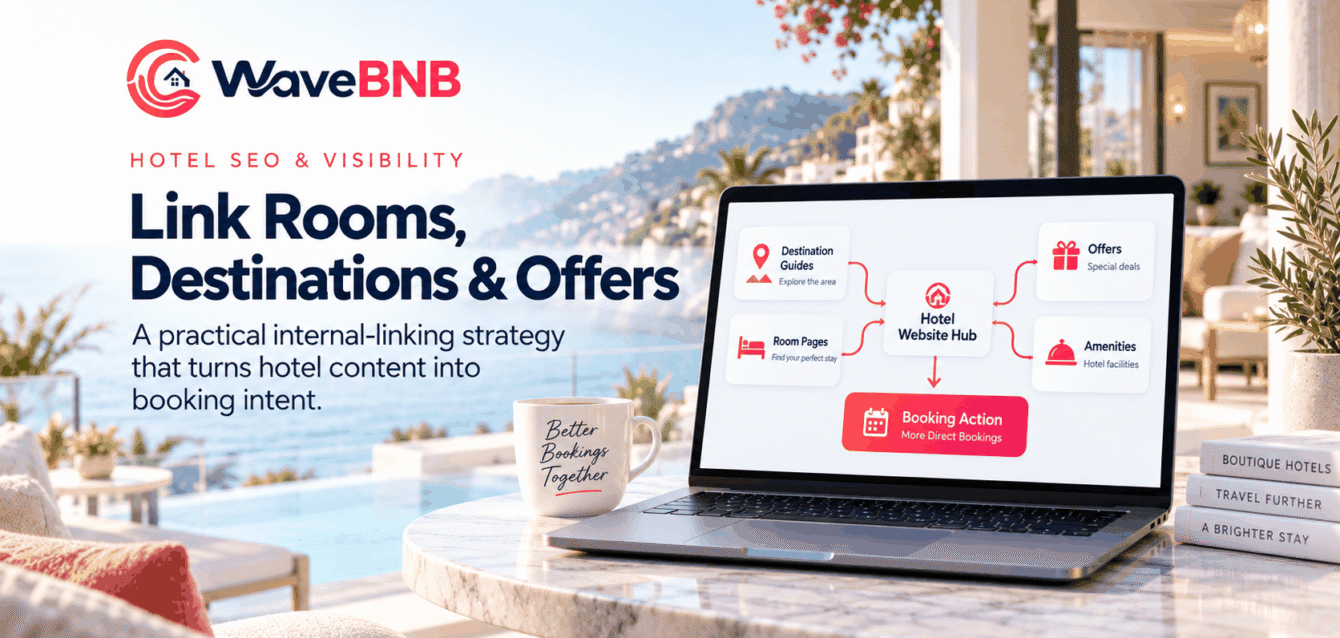
This guide sets out a practical hotel SEO internal linking strategy for rooms, destinations and offers. It focuses on page relationships, crawlable links, anchor text, seasonal content, booking-engine handoffs and measurement so the website becomes easier to understand and easier to use.
How should hotels structure internal links for rooms, destinations and offers?
Direct answer
Hotel SEO internal linking should connect every priority page to a clear site hierarchy and a useful next step: hubs to rooms and offers, destination content to relevant commercial pages, room pages to supporting amenities or packages, and active offers to eligible rooms and booking actions. Use crawlable HTML links with concise, descriptive anchor text. The goal is not to maximise link count, but to make page relationships clear and help travellers move from search intent towards booking intent.
| By | Daniel Rey Hospitality Growth Strategist, WaveBNB |
| Last updated | August 2026 |
| Experience | 9+ years in growth marketing, demand generation, SEO, paid acquisition, CRO, analytics and digital strategy across B2B SaaS, technology and hospitality. Experience managing multi-channel advertising budgets of up to £200k per month. |
| Editorial note | Content is reviewed and updated as search platforms, AI discovery, advertising systems, hospitality technology and digital marketing best practices evolve. |
| Sources | Google Search Central: SEO Link Best Practices; Help Google Understand Your Ecommerce Website Structure; Sitelinks; Google Search Console Links Report; Creating Helpful, Reliable, People-First Content. |
About the author
Daniel Rey is the Hospitality Growth Strategist at WaveBNB, specialising in helping independent hotels, boutique properties, resorts, vacation-rental operators and property management companies improve visibility, generate more profitable direct demand and convert more travellers into guests.
Daniel brings 9+ years of experience across growth marketing, demand generation and digital strategy, with expertise spanning SEO, Google Ads, paid social, CRO, lifecycle marketing, analytics, content strategy and AI automation. He has managed multi-channel advertising budgets of up to £200k per month and built acquisition and conversion programmes focused on measurable commercial outcomes rather than vanity metrics.
Through WaveBNB, his work focuses on the complete hospitality growth journey, from hotel SEO and AI-search visibility through paid acquisition, direct-booking conversion, analytics and AI-powered guest experiences. His approach connects visibility, qualified traffic and booking intent to direct revenue, conversion efficiency and sustainable hospitality growth.
Key takeaways
- Every priority hotel page should be reachable through at least one crawlable internal link from another relevant page. Do not rely on XML sitemaps to rescue pages the website barely references.
- Use a hierarchy that reflects how travellers decide: destination or need, property fit, room choice, offer or package, then booking action.
- Destination content should link forward to the most relevant rooms, amenities and offers. It should not become an isolated travel magazine with no commercial next step.
- Give rooms and offers stronger internal prominence when they matter commercially, but do not turn internal linking into a raw link-count exercise.
- Use concise, descriptive anchors that set the expectation for the next page. Avoid generic “click here” links and repeated exact-match anchors inserted only for SEO.
- Treat seasonal offers as part of a URL lifecycle. Remove links to expired pages and redirect only when there is a genuine replacement or consolidation target.
- Measure whether internal linking improves discovery and movement to commercial pages. Search Console’s Links report is useful, but Google notes that it is a sample rather than a complete link inventory.
Table of contents
- How should hotels structure internal links for rooms, destinations and offers?
- What hotel SEO internal linking should achieve
- Build the hotel site architecture before adding links
- The hotel internal linking model: link down, across, forward and back
- How to internally link room and suite pages
- How to internally link destination and local content
- How to internally link hotel offers and packages
- Use anchor text that describes the next page
- Use navigation, breadcrumbs and contextual links for different jobs
- How many internal links should a hotel page have?
- Internal linking mistakes that weaken hotel SEO
- A 7-step hotel internal linking audit
- Example: internal linking for a 40-room boutique hotel
- How to measure whether the strategy is working
- Frequently asked questions
- What is internal linking in hotel SEO?
- Which hotel pages should receive the most internal-link attention?
- How many internal links should I add to each hotel page?
- Should internal links use exact-match SEO keywords?
- Do hotel booking-engine links count as internal links?
- Should expired hotel offer pages be redirected?
- Can internal linking fix keyword cannibalisation?
- Sources and further reading
- Strong internal linking creates a clearer path from discovery to booking intent
- Next steps
What hotel SEO internal linking should achieve
Internal linking is the practice of linking one page on a website to another page on the same website. For hotel SEO, its job is to make the site easier to navigate, help search engines discover important URLs and make the relationship between destination, room, amenity, offer and practical-information pages easier to understand.
Google’s current link guidance says every page you care about should have a link from at least one other page on your site. It also recommends crawlable links and anchor text that is concise, descriptive and relevant to the destination page. Those principles matter especially on hotel websites because commercial content is often split across room templates, seasonal offers, destination guides, amenities and a separate booking engine.
COMMERCIAL PRINCIPLE
A good internal link answers two questions at once: “What else does this traveller need to know?” and “What is the next useful step towards a booking decision?” If a link helps neither the guest nor the site structure, it probably does not need to be there.
Source: Google Search Central – SEO Link Best Practices for Google
Build the hotel site architecture before adding links
Do not begin by opening a spreadsheet and adding five links to every article. First decide which pages own which intent. Internal links work best when the underlying architecture is coherent. If two pages are competing for the same search intent, extra links can reinforce the confusion rather than solve it.
Google explains in its ecommerce documentation that it analyses relationships between pages based on their linkages, and that navigation structures and cross-page links can influence its understanding of site structure. A hotel is not an ecommerce catalogue, but the architecture principle transfers cleanly: top-level hubs should lead to important detail pages, and supporting content should connect into those hubs and commercial pages.
| Layer | Typical hotel pages | Primary link job | Main risk |
|---|---|---|---|
| Core | Homepage, Rooms, Offers, Location, Dining/Spa where material | Expose the property’s main decision areas | Important pages buried behind abstract navigation |
| Commercial detail | Individual rooms/suites, meetings, weddings, spa, dining, parking | Help guests evaluate a concrete product or need | Pages receive traffic but have no route to related value |
| Intent / destination | Neighbourhood guides, venue pages, itineraries, seasonal guides | Capture research intent and move it forward | Blog traffic becomes a dead end |
| Promotional | Offers, packages, seasonal stays | Connect a reason to travel with the right room and terms | Expired or thin offers remain linked |
| Conversion | Availability and booking-engine actions | Turn resolved intent into a reservation step | External booking engine becomes the only path between pages |
The booking engine is important, but it should not replace the internal architecture. If the booking engine sits on another domain, its links are conversion links rather than internal links to the hotel website. Search engines and guests still need crawlable paths between the hotel’s own rooms, offers, location and supporting content.
Source: Google Search Central – Help Google understand your ecommerce website structure
The hotel internal linking model: link down, across, forward and back
A useful hotel linking system can be managed with four directions. This prevents the common mistake of linking every page to every other page and gives each link a clear job.
| Direction | Purpose | Hotel example | Use when |
|---|---|---|---|
| Link down | Move from a hub to a specific decision page | Rooms hub -> Deluxe King Room | A parent page introduces meaningful sub-options |
| Link across | Connect pages that solve the same guest need | Family room -> family-friendly amenities | The relationship helps comparison or reduces uncertainty |
| Link forward | Move research towards commercial intent | “48 hours in Bath” guide -> weekend offer | The visitor has enough context for the next decision |
| Link back | Restore hierarchy and context | Room page -> Rooms overview | A visitor may need to compare or step back |
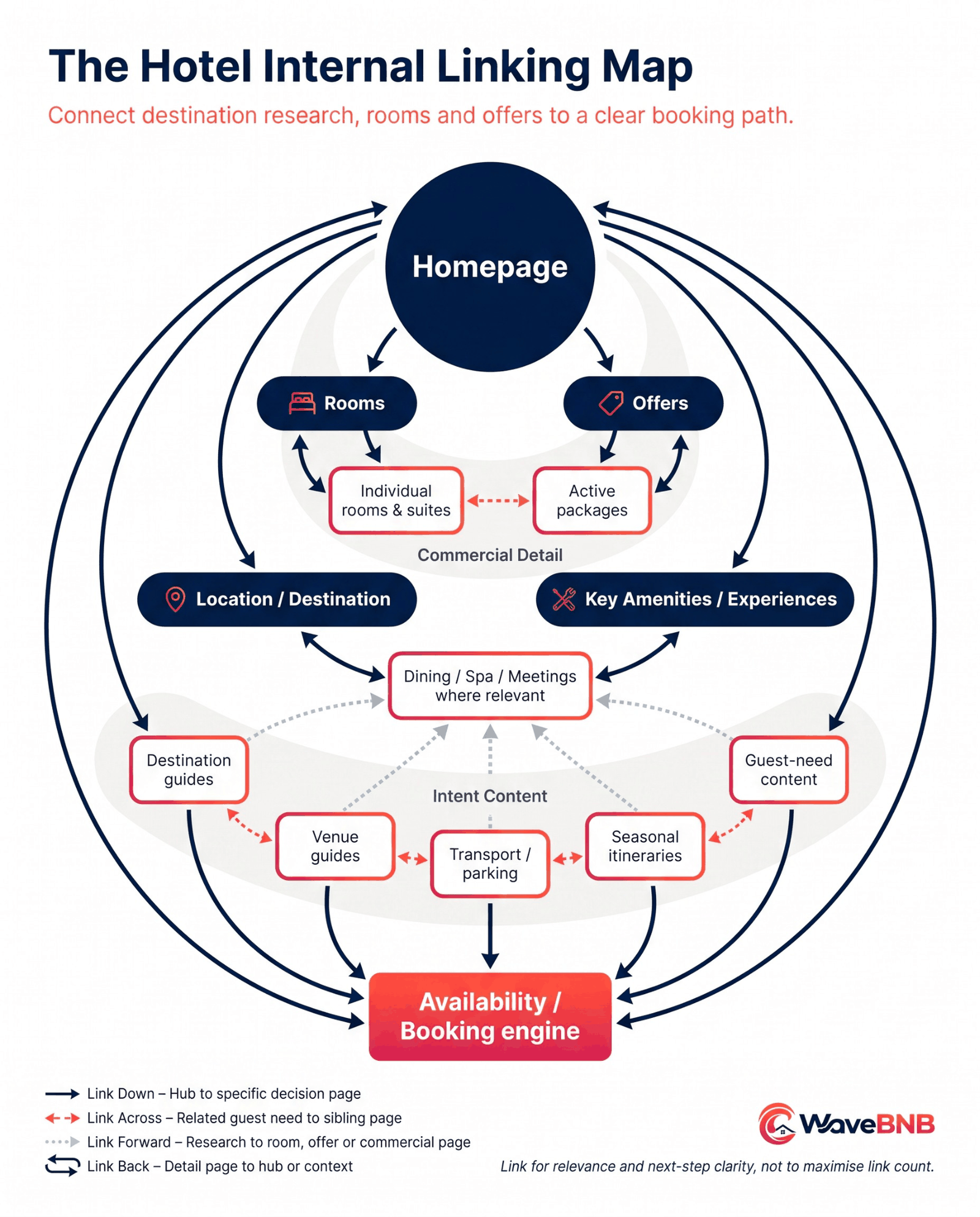
Use the model as a relevance test. A destination guide may deserve two or three different commercial links because it covers several trip needs. A narrow room page may need fewer. The number is secondary to whether each link has a clear relationship to the content around it.
How to internally link room and suite pages
Room pages sit close to revenue, so they should not depend on the main navigation alone. Each important room or suite should receive contextual links from the accommodation hub and from the destination, amenity or offer pages that make that room especially relevant.
- Link from the Rooms or Accommodation hub to every commercially important room type using the real room name or a concise descriptive label.
- Link from relevant destination and use-case content. A family guide can link to family rooms; a venue guide can link to a room type suited to short stays; a wellness page can link to rooms included in a spa package.
- Link from active offers to the room types that qualify. Do not make the guest open the booking engine just to discover which accommodation is included.
- Link back to the room comparison or accommodation hub when the guest may need to compare capacity, views, beds or inclusions.
- Keep important room links in normal HTML anchors. Do not hide the only route to a room inside a JavaScript-only carousel, filter or interaction that does not expose a crawlable href.
- Avoid inserting a body link from every room page to every other room page. Use a comparison module or the Rooms hub when the relationship is simply “other accommodation”.
A room page should also avoid becoming a link dump. Its primary job is to help the guest decide whether that room fits. Internal links should support that decision rather than pull the user into unrelated content.
How to internally link destination and local content
Destination content is where many hotel internal linking strategies fail. The guide ranks, attracts research traffic and then ends with another travel article. For WaveBNB’s SEO model, destination content should support qualified visibility and deliberately move readers towards pages that can create booking intent.
- Link a broad destination hub to useful neighbourhood, venue, transport, seasonal and itinerary content where those pages answer genuinely different questions.
- Link each guide forward to the most relevant hotel page. A guide to a conference venue can link to location, business-friendly rooms and a relevant stay offer. A family itinerary can link to family rooms, breakfast information and parking.
- Use first-hand, property-specific context in destination content so the page has a reason to exist beyond ranking for a city keyword.
- Link back from commercial pages when the destination content helps a booking decision. For example, a room page can link to a “Getting here from the station” guide if transport is a recurring guest question.
- Do not create near-duplicate destination pages for every small keyword variation. If the same topic, search intent and buyer intent are effectively identical, consolidate rather than multiplying pages.
THE DEAD-END TEST
Open every destination article and ask: if a qualified traveller reads this page, what is the most useful commercial page to see next? If there is no relevant answer, the content may be too broad for the hotel’s SEO strategy or it needs a clearer relationship to the property.
Source: Google Search Central – Creating Helpful, Reliable, People-First Content
How to internally link hotel offers and packages
Offer pages sit between demand and product. They should be linked from the places where the reason to travel becomes relevant, and they should link into the rooms, amenities and practical information needed to complete the decision.
- Link active priority offers from the homepage or Offers hub when they matter to current demand.
- Link destination or seasonal guides to the offer only when the offer genuinely matches the visitor’s intent.
- Link the offer to eligible rooms, included amenities or experiences, key terms and the relevant booking action.
- For recurring annual offers, prefer a stable URL when the underlying intent and proposition remain substantially the same, then update the dates, terms and content rather than creating a new near-duplicate URL every year.
- When an offer ends, remove internal links to it. If there is a genuine replacement or the content has been consolidated into an evergreen page, redirect to that relevant destination. Do not redirect unrelated expired offers to the homepage simply to avoid a 404.
Google’s current migration guidance warns against redirecting many old URLs to one irrelevant destination because that can confuse users and may be treated as a soft 404. For hotels, this matters when seasonal packages, event offers and old campaign URLs accumulate over several years.
Source: Google Search Central – Site Moves and Migrations
Use anchor text that describes the next page
Anchor text should tell the traveller what they will get after the click. Google recommends text that is descriptive, reasonably concise and relevant to both the source page and the destination page. That is a better rule than trying to force the exact target keyword into every link.
| Weak anchor | Better hotel anchor | Why it is better |
|---|---|---|
| Click here | Explore our family rooms | Explains the destination and matches the surrounding family context. |
| Read more | See rooms near Central Station | Gives the user a clear next step from a transport or venue guide. |
| Offer | View the winter city-break package | Names the proposition rather than using a generic label. |
| Best boutique hotel rooms in Bath | Deluxe King rooms | Avoids awkward exact-match stuffing while staying descriptive. |
| More information | Parking and driving directions | Sets a precise expectation for practical information. |
Natural variation is normal. A room may be linked as “Deluxe King”, “our Deluxe King room” or “rooms with a city view” depending on the sentence. The goal is clarity, not a sitewide exact-match pattern.
Source: Google Search Central – SEO Link Best Practices for Google
Use navigation, breadcrumbs and contextual links for different jobs
Not all internal links should do the same job. A strong hotel site combines stable navigation with hierarchy cues and context-specific links rather than trying to solve everything through the main menu or footer.
| Link type | Best use | Hotel example | Avoid |
|---|---|---|---|
| Primary navigation | Expose the highest-value site sections | Rooms, Offers, Location, Experiences | Adding every campaign or blog category |
| Breadcrumbs | Show hierarchy and a route back | Home > Rooms > Deluxe King | Using them as the only link to a parent page |
| Contextual body links | Connect intent to the next useful decision | Venue guide -> relevant room or offer | Random keyword-rich links unrelated to the paragraph |
| Cards / related content | Support comparison and exploration | Related rooms or destination guides | Generic “Read more” cards with unclear destinations |
| Footer | Utility and stable secondary navigation | Contact, policies, accessibility, key sections | Dozens of SEO links to every city and offer page |
Google’s sitelinks guidance recommends a logical site structure, links to important pages from relevant pages and concise, relevant anchor text. Breadcrumb structured data can additionally describe a page’s position in the site hierarchy, but the visible user journey still matters.
Source: Google Search Central – Sitelinks
Source: Google Search Central – Breadcrumb structured data
How many internal links should a hotel page have?
Do not set a universal quota. A concise room page may need only a few meaningful internal links beyond navigation, while a long destination guide can reasonably connect to several rooms, amenities, offers and related guides. The right number depends on the page’s purpose and how many genuinely useful next steps exist.
Instead of counting links, review three things: relevance, prominence and coverage. Relevant links make sense in context. Prominent links appear where users can see and understand them. Coverage means every priority page has at least one useful route into it, rather than some pages receiving dozens of links while other commercially important URLs are orphaned.
BETTER RULE THAN A QUOTA
Add the fewest links needed to make the page relationship and next step clear, then add more only where they answer a real comparison, planning or booking question.
Internal linking mistakes that weaken hotel SEO
- Orphaning new room, venue or offer pages because they were published outside the main navigation workflow.
- Linking every supporting article back to the homepage instead of to the most relevant room, offer, location or amenity page.
- Publishing destination content that links only to more destination content and never progresses towards the property.
- Using generic “read more” or “click here” anchors when a descriptive label would make the destination clearer.
- Using the same exact-match keyword anchor repeatedly across dozens of pages even when the wording is unnatural.
- Hiding important links inside interactions that do not expose a normal crawlable HTML link.
- Keeping expired offers linked from old guides, menus or campaign pages.
- Redirecting obsolete offer URLs to irrelevant destinations such as the homepage.
- Creating new location, amenity or offer pages for tiny keyword variations when an existing page already owns the same intent.
- Treating the booking-engine button as the only meaningful link on every page, leaving the hotel website’s own commercial pages weakly connected.
A 7-step hotel internal linking audit
Audit internal linking as a commercial architecture exercise, not just a crawler metric. Start with the pages closest to booking intent and work outward into supporting content.
| Step | Action | Question to answer | Output |
|---|---|---|---|
| 1 | Inventory priority URLs | Which rooms, offers, location, amenities and destination pages matter most? | Priority URL list |
| 2 | Assign one page owner per intent | Is another URL targeting the same topic and buyer intent? | Intent / ownership map |
| 3 | Crawl the current link graph | Which pages have few or no inlinks, and which are unnecessarily dominant? | Baseline link map |
| 4 | Fix orphan and underlinked pages | What relevant hub or content page should link to each priority URL? | Critical fixes |
| 5 | Map contextual opportunities | Where can a traveller progress naturally from research to evaluation? | Source -> target plan |
| 6 | Improve link format and anchors | Are important links crawlable and descriptively labelled? | Implementation list |
| 7 | Measure after changes | Are target pages easier to discover and are users progressing to commercial actions? | 30/60/90-day review |
Use a crawler for the detailed link graph, but cross-check the result against Google Search Console. Search Console’s Links report shows top internally linked pages and which pages link to a selected URL, although Google states that the report is a sample and is not comprehensive.
Source: Google Search Console Help – Links report
Example: internal linking for a 40-room boutique hotel
The following is a fictional example designed to show the logic. It is not a WaveBNB client result or a performance claim.
| Source page | Best internal destination | Anchor example | Reason |
|---|---|---|---|
| Homepage | Rooms hub | Explore rooms and suites | Exposes the main accommodation decision area. |
| Rooms hub | Family Room | Family Room | Moves from category to a specific room type. |
| “Weekend in the city” guide | Weekend stay offer | View the weekend stay offer | Connects inspiration to a relevant package. |
| Conference venue guide | Deluxe King Room | Rooms near the conference centre | Matches a likely short-stay business need. |
| Family itinerary | Family Room + breakfast page | Explore family rooms / Breakfast information | Resolves product fit and a practical decision question. |
| Winter stay offer | Eligible room pages | Choose your room | Makes the package-to-room relationship explicit. |
| Deluxe King Room | Rooms hub + spa package | Compare all rooms / View the spa package | Supports comparison and a relevant upsell path. |
| Parking page | Location / driving guide | Plan your journey | Keeps practical information connected rather than isolated. |
Notice what is missing: there is no instruction to link every page to every room. Each relationship has a guest-intent reason. That keeps the architecture understandable and prevents the site from becoming a dense web of low-value cross-links.
How to measure whether the strategy is working
Internal linking should be measured through both search discovery and user movement. A change that increases a room page’s internal links but sends irrelevant visitors there is not automatically an improvement.
- Crawl coverage: confirm every priority page has at least one crawlable internal link and review inlink counts, crawl paths and orphan URLs in your crawler.
- Search Console Links report: check whether your core room, offer and destination pages appear where expected in the internal-link sample, and inspect which URLs link to a priority page.
- Search performance: monitor impressions, clicks and query coverage for the commercial pages you strengthened. Separate branded and non-brand demand where that distinction is useful.
- Commercial-page engagement: measure whether organic landing pages send more qualified visitors to rooms, offers, location pages or other high-intent destinations.
- Booking intent: track availability checks, booking-engine starts and completed bookings where the analytics setup supports reliable attribution.
- Cannibalisation: review whether multiple URLs are receiving impressions for the same priority query cluster. Internal links can clarify page ownership, but same-intent duplicate content may still need to be differentiated or consolidated.
WAVEBNB MEASUREMENT PRINCIPLE
Traffic is not success by itself. For Hotel SEO & Visibility, the primary KPI is non-brand organic sessions, supported by high-intent visibility, qualified engagement and measurable movement towards booking intent. Internal linking should strengthen that journey rather than optimise an isolated crawler score.
Frequently asked questions
What is internal linking in hotel SEO?
Internal linking is the use of links between pages on the same hotel website. A hotel SEO internal linking strategy organises those links so search engines and travellers can discover important rooms, offers, destination content and practical information, understand how the pages relate and move towards the next useful decision.
Which hotel pages should receive the most internal-link attention?
Start with pages closest to booking intent and pages that support them: the homepage, Rooms hub, important room and suite pages, Offers, Location, key amenities or experiences, and destination pages that attract qualified search demand. Give priority based on commercial importance and relevance, not simply on which page already receives the most traffic.
How many internal links should I add to each hotel page?
There is no useful universal quota. Add links where they help the visitor understand, compare or progress. A short room page may need only a few contextual links, while a detailed destination guide may justify several. Coverage and relevance matter more than hitting a fixed number.
Should internal links use exact-match SEO keywords?
Not as a rule. Use concise, descriptive anchor text that reads naturally and sets the expectation for the destination page. Exact wording can be appropriate when it is the natural page or room name, but repeating an awkward keyword phrase across the site is unnecessary.
Do hotel booking-engine links count as internal links?
Only when the booking engine is on the same site. Many hotel booking engines use another domain or subdomain. Those links are still essential conversion actions, but they should not replace crawlable links between the hotel website’s own room, offer, destination and practical-information pages.
Should expired hotel offer pages be redirected?
Redirect when the old offer has a genuine replacement or its content has been consolidated into a clearly relevant evergreen page. If there is no suitable replacement, remove internal links and allow the old URL to return an appropriate 404 or 410 rather than forcing visitors to an unrelated homepage.
Can internal linking fix keyword cannibalisation?
It can help clarify which page is the preferred destination for a topic, but it cannot fix fundamentally duplicate search intent by itself. When two pages target the same topic, search intent and buyer intent, consider merging, differentiating or retiring one of them as well as adjusting internal links.
Sources and further reading
- Google Search Central – SEO Link Best Practices for Google
- Google Search Central – Help Google understand your ecommerce website structure
- Google Search Central – Sitelinks
- Google Search Console Help – Links report
- Google Search Central – Creating Helpful, Reliable, People-First Content
- Google Search Central – What is canonicalization?
- Google Search Central – Site Moves and Migrations
Strong internal linking creates a clearer path from discovery to booking intent
Start with the twenty pages closest to a booking decision rather than trying to rebuild the whole website at once. List the homepage, Rooms hub, priority room types, active offers, Location, high-value amenities and the destination pages already attracting qualified traffic. For each page, define its parent, the most relevant sibling relationship and the next useful commercial destination. Then fix orphan pages and weak contextual links before expanding the content calendar.
Next steps
Book a Growth Audit
WaveBNB can review page ownership, orphan pages and the internal links connecting destination content, rooms and offers as part of a wider hotel visibility and growth audit.
Explore Hotel SEO & Visibility
Explore Hotel SEO & Visibility to see how WaveBNB approaches search visibility across Google Search, Maps and AI discovery.