




Estimated reading time: 20 minutes
Technical SEO for hotels matters because a hotel website can look polished and still be difficult for search engines to crawl, understand or index. For example, room pages can compete with filtered booking URLs, destination pages can become orphaned, JavaScript can hide important content, and image-heavy templates can make mobile pages slow at exactly the moment a traveller is deciding where to stay.
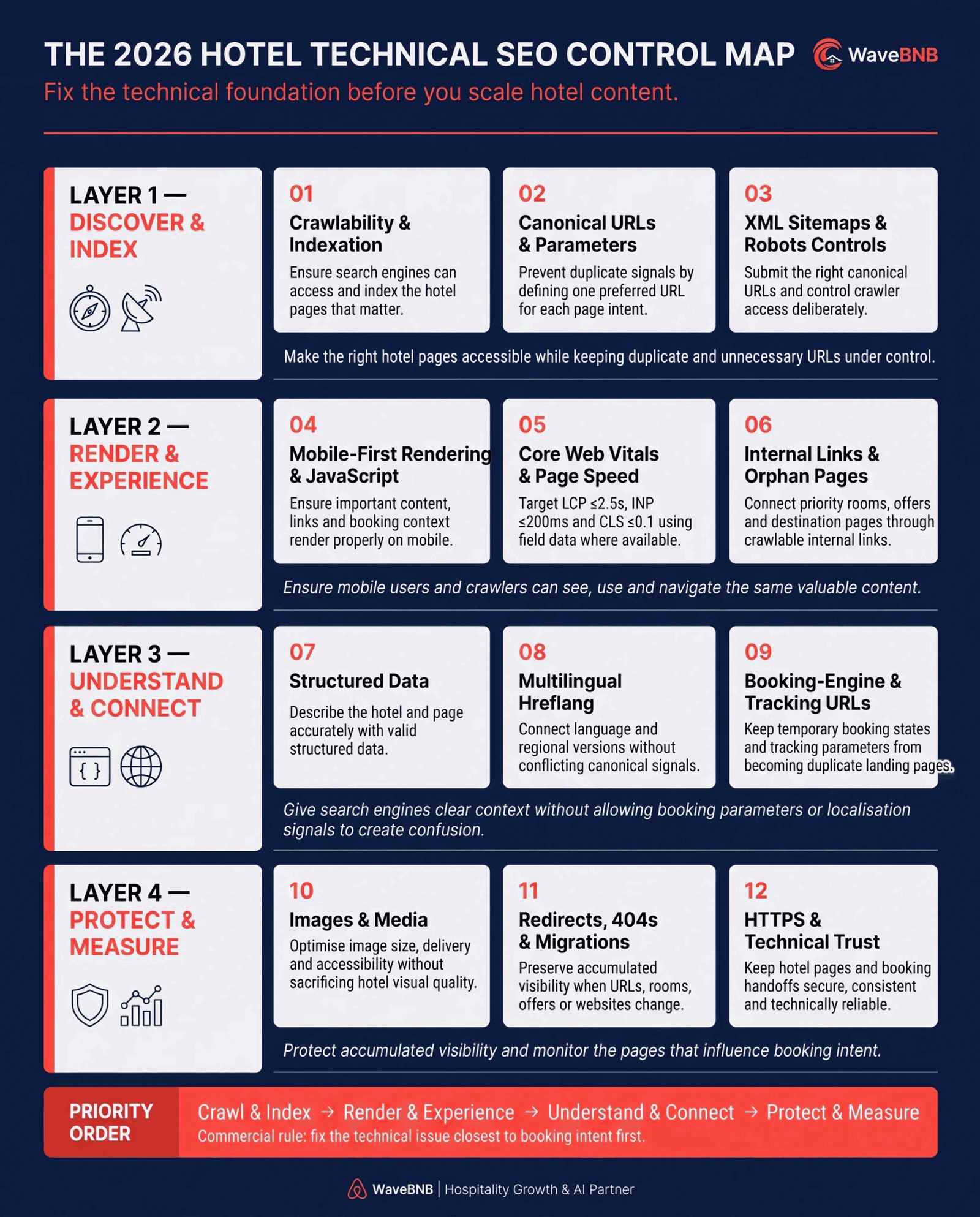
Technical SEO fixes that foundation. Therefore, this 2026 checklist is designed for independent hotels, boutique properties and resorts that want their highest-value pages to be discoverable in Google without turning the website into a technical project for its own sake. The aim is simple: make the right pages easy to find, easy to interpret and fast enough to support booking intent.
What is technical SEO for hotels?
Direct answer
Technical SEO for hotels is the process of making a hotel website crawlable, indexable, fast, mobile-friendly and technically unambiguous. In 2026, the highest-priority checks are indexing controls, canonical URLs, XML sitemaps, crawlable internal links, mobile rendering, Core Web Vitals, JavaScript accessibility, structured data, multilingual hreflang and control of booking or parameter URLs that can create duplicates.
| By | Daniel Rey, Hospitality Growth Strategist, WaveBNB |
| Last updated | August 2026 |
| Experience | 9+ years in growth marketing, demand generation, SEO, paid acquisition, CRO, analytics and digital strategy across B2B SaaS, technology and hospitality. Experience managing multi-channel advertising budgets of up to £200k per month. |
| Editorial note | Content is reviewed and updated as search platforms, AI discovery, advertising systems, hospitality technology and digital marketing best practices evolve. |
| Sources | Based on Daniel’s professional marketing experience, WaveBNB’s hospitality growth methodology, first-party analysis and recognised industry, platform and hospitality research cited throughout each article. |
About the author
Daniel Rey is the Hospitality Growth Strategist at WaveBNB, specialising in helping independent hotels, boutique properties, resorts, vacation-rental operators and property management companies improve visibility, generate more profitable direct demand and convert more travellers into guests.
Daniel brings 9+ years of experience across growth marketing, demand generation and digital strategy, with expertise spanning SEO, Google Ads, paid social, CRO, lifecycle marketing, analytics, content strategy and AI automation. He has managed multi-channel advertising budgets of up to £200k per month and built acquisition and conversion programmes focused on measurable commercial outcomes rather than vanity metrics.
Through WaveBNB, his work focuses on the complete hospitality growth journey, from hotel SEO and AI-search visibility through paid acquisition, direct-booking conversion, analytics and AI-powered guest experiences. His approach connects visibility, qualified traffic and booking intent to direct revenue, conversion efficiency and sustainable hospitality growth.
Key takeaways
- Index only URLs that deserve to appear in search. Search, filter, tracking and booking-parameter URLs should not be allowed to create uncontrolled duplicate pages.
- Use stable, self-canonical URLs for indexable pages. Use permanent server-side redirects when a page genuinely moves and real 404 or 410 responses when it is removed without a replacement.
- Treat mobile as the primary version of the site. Google uses the mobile version for indexing and ranking, so desktop-only content or links can create visibility gaps.
- Measure Core Web Vitals with field data where possible. Good thresholds are LCP at 2.5 seconds or less, INP at 200 milliseconds or less and CLS at 0.1 or less at the 75th percentile.
- Structured data should describe what is genuinely on the page. It can help search engines understand the property and article, but it is not a substitute for crawlability, content quality or hotel rate feeds.
- Prioritise technical fixes by commercial impact. A blocked room or destination page matters more than a minor warning on a low-value archive page.
Table of contents
- What is technical SEO for hotels?
- What technical SEO means for a hotel website
- The 2026 technical SEO checklist
- 1. Crawlability and indexation
- 2. URL architecture, canonicals and parameters
- 3. XML sitemaps and robots controls
- 4. Mobile-first rendering and JavaScript
- 5. Site speed and Core Web Vitals
- 6. Internal linking and orphan pages
- 7. Structured data for hotels and content
- 8. International and multilingual hotel websites
- 9. Booking engines, rate URLs and tracking parameters
- 10. Images and media
- 11. Redirects, 404s and website migrations
- 12. HTTPS, security and technical trust
- How to prioritise technical SEO fixes
- How to measure technical SEO performance
- Sources and further reading
- Frequently asked questions
- Conclusion: make technical SEO serve booking intent
- Next steps
What technical SEO means for a hotel website
Technical SEO is the infrastructure layer of hotel SEO. In practice, it determines whether search engines can discover a URL, access its content, understand which version is canonical, render the page on mobile and interpret how the page fits into the wider website.
Moreover, for hotels, the technical layer is unusually important because the site often combines several systems: a content management system, a booking engine, analytics and advertising tags, third-party widgets, image galleries, maps, consent tools and sometimes multiple languages or properties. As a result, each additional system can create new URLs, scripts or loading dependencies.
The objective is not to make every technical score perfect. Instead, the objective is to protect the pages that create qualified discovery and booking intent, such as the home page, room and suite pages, destination pages, offers, wedding or meeting pages, restaurant pages and other commercially useful content.
The 2026 technical SEO checklist
Run the checklist in this order. In particular, the sequence matters because fixing speed or schema has limited value if the page is blocked from crawling, canonicalised elsewhere or disconnected from the site through poor internal linking.
1. Crawlability and indexation
To begin with, confirm that every page you want to rank is accessible to search-engine crawlers and eligible for indexing. Otherwise, a visually perfect room page is useless for organic discovery if a robots rule, noindex directive, login requirement or server error prevents Google from accessing it.
| Check | What good looks like | Priority |
|---|---|---|
| Indexable commercial pages | Home, rooms, suites, offers, destination and other target landing pages return 200 and do not carry noindex. | Critical |
| Utility pages controlled | Internal search results, account pages and other low-value utilities are excluded intentionally rather than by accident. | High |
| Noindex can be seen | A page using noindex is not simultaneously blocked in robots.txt, because crawlers need access to read the directive. | High |
| Search Console checked | Page Indexing and URL Inspection are used to compare intended indexing with Google’s actual view. | High |
Google states that a noindex rule only works when the crawler can access the page and read it. However, blocking the same URL in robots.txt can prevent the crawler from seeing the noindex directive. See Google’s noindex guidance.
HOTEL-SPECIFIC WARNING
For example, do not treat every booking-engine URL as an SEO landing page. Availability searches, date combinations, occupancy parameters and internal search states can generate huge numbers of low-value URLs. Keep the organic landing page set deliberate and finite.
2. URL architecture, canonicals and parameters
For example, hotels commonly create duplicate or near-duplicate URLs through campaign tracking, filters, date selectors, room searches, language parameters and legacy website paths. Canonicalisation tells search engines which representative URL you prefer when multiple URLs contain the same or very similar primary content.
| Check | What good looks like | Priority |
|---|---|---|
| One stable URL per page intent | Each indexable room, destination, offer or facility page has a clean permanent URL. | Critical |
| Self-referencing canonical | The preferred version of an indexable page points to itself unless there is a deliberate consolidation case. | High |
| Parameter duplicates consolidated | Tracking, sort, filter or booking parameters do not create competing indexable versions of the same content. | High |
| HTTP/HTTPS and host consistency | HTTP, www/non-www and other duplicate host variants resolve consistently to the chosen version. | High |
| No fragment-based core pages | Essential page content does not depend on URL fragments such as #/rooms to create separate crawl targets. | Medium |
In addition, Google describes rel=canonical as a strong signal of your preferred representative URL, but not an absolute rule. Redirects, sitemap inclusion and other signals also contribute. See Google’s canonicalisation documentation.
For hotel websites, the practical rule is to keep the public organic URL clean and let analytics handle campaign attribution. For example, a URL such as /rooms/ocean-suite/ should remain the canonical page even when visitors arrive with UTM or other tracking parameters attached.
3. XML sitemaps and robots controls
An XML sitemap is a discovery and monitoring aid, not a replacement for internal links. Therefore, include only the canonical URLs you actually want search engines to process, then keep the sitemap current when rooms, offers or destination content are added, removed or moved.
| Check | What good looks like | Priority |
|---|---|---|
| Sitemap contains canonical pages | Only indexable 200-status canonical URLs are submitted. | High |
| Sitemap is current | Removed and redirected URLs are not left in the active sitemap indefinitely. | Medium |
| Sitemap submitted in Search Console | The property can monitor discovery and indexing against the submitted set. | High |
| Robots.txt is intentional | Important pages, CSS, JavaScript and required media are not blocked accidentally. | Critical |
| Sitemap size within protocol limits | If needed, split files before 50,000 URLs or 50 MB uncompressed per sitemap. | Low for most hotels |
For reference, Google’s current sitemap guidance sets a limit of 50,000 URLs or 50 MB uncompressed per sitemap file. However, most independent hotel sites will be far below this, so the more useful goal is accuracy, not scale. See Google’s sitemap guidance.
However, advanced crawl-budget optimisation is rarely a priority for a normal independent hotel website. Google’s crawl-budget guide is aimed mainly at sites with around one million or more pages, rapidly changing sites with more than 10,000 pages, or sites with a large discovered-but-not-indexed problem. See Google’s crawl-budget guidance.
4. Mobile-first rendering and JavaScript
Importantly, Google uses the mobile version of a site’s content for indexing and ranking. Therefore, mobile parity is a technical SEO requirement, not simply a design preference. If desktop contains room descriptions, destination copy, internal links or structured data that mobile removes, search engines may have less information to work with.
| Check | What good looks like | Priority |
|---|---|---|
| Mobile content parity | Primary copy, headings, links, image context and metadata are equivalent on mobile and desktop. | Critical |
| Important content renders without interaction | Users do not have to click, swipe or type before search engines can load essential content. | High |
| JavaScript output is inspectable | Key text and links appear in the rendered HTML seen in URL Inspection. | High |
| Links use real href attributes | Navigation and internal links use crawlable <a href> links rather than script-only click handlers. | High |
| Resources crawlable | CSS and JavaScript required to understand the page are accessible to Google. | High |
For this reason, Google recommends responsive design and says its mobile crawler uses the mobile version for indexing and ranking. It also warns that primary content should not require user interaction to load. See mobile-first indexing best practices.
Similarly, for links, Google says a normal HTML anchor with an href attribute is the most reliable crawlable pattern. See Google’s link best practices.
5. Site speed and Core Web Vitals
Hotel websites are often image-heavy and widget-heavy. For example, large hero photography, carousels, booking widgets, chat tools, tag managers and consent scripts can all delay the moment a guest sees or can interact with the page. Therefore, speed work should focus on the real template and the real mobile journey, not only a laboratory score.
| Check | What good looks like | Priority |
|---|---|---|
| Largest Contentful Paint | Aim for LCP of 2.5 seconds or less at the 75th percentile. | High |
| Interaction to Next Paint | Aim for INP of 200 milliseconds or less at the 75th percentile. | High |
| Cumulative Layout Shift | Aim for CLS of 0.1 or less at the 75th percentile. | High |
| Hero media optimised | Serve correctly sized responsive images and avoid unnecessarily heavy media above the fold. | High |
| Third-party scripts controlled | Remove redundant tags and load non-essential tools without blocking the primary page experience. | High |
| Field data reviewed | Use Search Console Core Web Vitals and real-user data where available, not only one-off lab tests. | Medium |
Specifically, the current Core Web Vitals ‘good’ thresholds are LCP at 2.5 seconds or less, INP at 200 milliseconds or less and CLS at 0.1 or less, assessed at the 75th percentile. See web.dev’s Core Web Vitals guidance.
DO NOT OPTIMISE SPEED IN ISOLATION
However, a faster page that removes useful room information, imagery or booking context can still perform worse commercially. Therefore, protect the content and booking journey first, then reduce unnecessary payload, blocking scripts and layout instability.
6. Internal linking and orphan pages
Search engines discover pages through links, and guests use the same architecture to move from inspiration to evaluation. Therefore, a hotel should not rely on an XML sitemap to rescue pages that the website itself barely links to.
| Check | What good looks like | Priority |
|---|---|---|
| Every priority page has an internal link | Important pages are linked from at least one relevant hub or navigation path. | Critical |
| Room pages linked contextually | Room and suite pages are connected from accommodation hubs, offers and relevant supporting content. | High |
| Destination content links forward | Destination guides link naturally to the rooms, offers or experiences that match the traveller intent. | High |
| Anchors are descriptive | Link text explains the destination instead of relying on generic phrases such as learn more. | Medium |
| Broken links removed | Internal links do not send users or crawlers through avoidable 404s or redirect chains. | High |
Accordingly, Google recommends that every page you care about has a link from at least one other page on the site and that anchor text should be descriptive and relevant. See Google’s link best practices.
For example, a practical hotel hierarchy is usually: home page to accommodation or destination hub, hub to individual room or experience page, supporting article to the relevant commercial page, then a clear path to booking intent. This is both an SEO architecture and a guest journey.
7. Structured data for hotels and content
Structured data gives machines explicit information about a page, but it does not repair weak content or technical access. Instead, use markup that accurately reflects visible content, validate it, and avoid treating every possible schema.org property as a ranking tactic.
| Check | What good looks like | Priority |
|---|---|---|
| Hotel or LodgingBusiness semantics | Use the most specific factual schema.org type that matches the property, such as Hotel or Resort, where appropriate. | Medium |
| Organisation data consistent | Business name, URL, logo and relevant identity data are consistent on the organisation or about page. | Medium |
| Breadcrumb structured data | The page hierarchy can be represented consistently where breadcrumbs are visible. | Medium |
| Article markup on editorial content | Blog posts use Article or BlogPosting with accurate headline, author, image and dates where applicable. | Medium |
| Markup validated | Test supported Google features in Rich Results Test and inspect representative live URLs. | Medium |
| No invented ratings or offers | Structured data matches what users can see and does not fabricate prices, reviews or availability. | Critical |
For example, Schema.org provides a hotel model that distinguishes the lodging business, accommodation units and offers. For Google Search features, however, Google advises using its own Search Central documentation as the definitive source for supported rich-result behaviour. See schema.org hotel markup and Google’s structured data introduction.
In addition, hotel schema is not a replacement for rate distribution. If a property wants to participate in Google’s free booking links or Hotel Ads, Google describes a separate Hotel Center or connectivity-partner process for sending rates and availability. See Google’s hotel connectivity guidance.
8. International and multilingual hotel websites
Hotels serving international guests often need language or region variants. However, the technical risk is that the same or similar page exists in several versions while search engines are given inconsistent signals about which URL belongs to which audience.
| Check | What good looks like | Priority |
|---|---|---|
| Dedicated URLs per language or region | Each localised version has a stable crawlable URL. | High |
| Hreflang is reciprocal | Each language version lists itself and the other alternate versions. | High |
| Language-region codes valid | Use supported language codes and optional country codes such as en-US or en-GB. | High |
| Canonical logic does not fight hreflang | Regional variants that should rank separately are not all canonicalised to one global page. | Critical |
| Main content genuinely localised | Do not create thin locale shells where only navigation changes while the body remains effectively identical. | Medium |
Accordingly, Google says hreflang can be implemented in HTML, HTTP headers or sitemaps, and each language version should list itself and all alternate versions. See Google’s localisation guidance.
9. Booking engines, rate URLs and tracking parameters
The booking engine is where hotel SEO meets conversion. At the same time, it is a common source of technical clutter because availability searches can append dates, rooms, guests, currencies, promo codes and campaign parameters to URLs.
| Check | What good looks like | Priority |
|---|---|---|
| Organic pages remain the discovery layer | Room, offer and destination pages on the main site contain the indexable content that should rank. | Critical |
| Ephemeral search states controlled | Date, occupancy, currency and search-result combinations are not allowed to become a second uncontrolled indexable site. | High |
| Tracking parameters do not create canonicals | Campaign parameters preserve measurement without changing the preferred organic URL. | High |
| Booking links are crawlable where useful | Calls to action use normal links or buttons that resolve to stable booking destinations for users. | Medium |
| Cross-domain measurement tested | If the booking engine is on another domain, analytics and referral handling are tested so SEO traffic is not misattributed. | High for measurement |
However, there is no universal configuration because booking engines differ. Therefore, the safe principle is to separate pages designed to earn search visibility from temporary booking states designed to complete a transaction. If the engine supports canonical, noindex or parameter controls, configure them deliberately and test the rendered output rather than assuming the default is search-friendly.
10. Images and media
Photography sells hotels, so image optimisation should not mean stripping the site of visual quality. Instead, it means serving the right file, at the right size, in a format and loading pattern that preserves both discovery and page performance.
| Check | What good looks like | Priority |
|---|---|---|
| Responsive image delivery | Browsers receive appropriately sized images rather than desktop originals on mobile. | High |
| Descriptive alt text | Important images use concise alt text that describes the image where that context helps users. | Medium |
| Stable image URLs | Core imagery does not receive a brand-new URL on every page load. | Medium |
| Primary images visible without interaction | Important visual content is not hidden behind interaction-dependent loading. | Medium |
| Image dimensions reserved | Width and height or equivalent CSS prevent avoidable layout shifts. | High |
For example, for decorative images, empty alt text can be appropriate. For meaningful room, venue or amenity imagery, write alt text for accessibility and context, not as a place to repeat the target keyword.
11. Redirects, 404s and website migrations
Hotel sites change frequently. For example, seasonal offer pages expire, room names change, a rebrand alters URL structure, or a new website replaces an old CMS. As a result, these changes can either preserve accumulated signals or quietly break them.
| Check | What good looks like | Priority |
|---|---|---|
| Permanent moves use server-side redirects | Use 301 or 308 when a URL has permanently moved to a relevant replacement. | Critical |
| Removed pages return real 404 or 410 | If there is no meaningful replacement, return an actual not-found or gone status. | High |
| No mass redirect to home page | Old URLs map to relevant destinations rather than all being sent to the home page. | Critical |
| Redirect chains removed | Internal links point directly to the final live URL. | High |
| Migration map maintained | Before redesigns or domain moves, map old URLs to new equivalents and update internal links, canonicals and sitemaps. | Critical |
Accordingly, Google recommends permanent server-side redirects for permanent URL moves and says removed pages without replacements should return 404 or 410. See redirect guidance and crawl-error guidance.
12. HTTPS, security and technical trust
Every public hotel page and booking handoff should use HTTPS consistently. In addition to search considerations, guests are entering dates, names and often payment details during the booking journey, so mixed-content warnings, expired certificates or insecure redirects damage trust at the point of conversion.
| Check | What good looks like | Priority |
|---|---|---|
| HTTPS is sitewide | Indexable pages resolve securely and HTTP versions redirect to HTTPS. | Critical |
| No mixed-content warnings | Secure pages do not load important insecure scripts, images or forms. | High |
| Certificates monitored | Expiry or hostname issues are detected before they affect guests. | High |
| Canonical and sitemap URLs use HTTPS | Technical signals agree on the secure version. | High |
| Staging sites protected | Development copies are not accidentally indexable or publicly discoverable. | High |
How to prioritise technical SEO fixes
A technical audit can produce hundreds of warnings. However, do not treat them as equal. Instead, prioritise based on the number of commercially valuable pages affected, the severity of the failure and how directly the issue blocks discovery or booking intent.
| Priority | Typical issue | Why it matters | Example hotel action |
|---|---|---|---|
| P0: blocking | Important page noindexed, robots blocked, 5xx errors, mobile content missing | Prevents discovery or access | Restore crawlability and indexability before other optimisation |
| P1: consolidating | Wrong canonicals, duplicate parameter URLs, broken hreflang, orphaned money pages | Splits signals or sends search engines to the wrong version | Fix canonical ownership, language mapping and internal links |
| P2: performance | Poor Core Web Vitals, heavy media, excessive third-party scripts | Weakens user experience and can reduce conversion efficiency | Optimise templates and scripts using field data |
| P3: enhancement | Non-critical schema warnings, secondary metadata refinements | Useful only after the foundation works | Validate and improve machine-readable context |
COMMERCIAL RULE
Therefore, fix the technical issue closest to revenue first. For example, a blocked suite page with strong demand is more important than a minor warning on a tag archive. Ultimately, technical SEO should move qualified travellers toward a page that can create booking intent.
How to measure technical SEO performance
Technical SEO is not successful because a crawler score increased. Instead, use technical metrics as leading indicators, then connect them to organic visibility and booking behaviour.
| Layer | What to monitor | What success looks like |
|---|---|---|
| Indexation | Search Console Page Indexing, sitemap coverage, URL Inspection | Priority pages indexed, accidental pages controlled, unexplained exclusions reduced |
| Technical quality | Core Web Vitals, 4xx/5xx errors, redirect chains, canonical conflicts | Fewer blocking errors and stronger mobile field performance |
| Visibility | Non-brand impressions, clicks and rankings by room, destination and commercial cluster | More qualified discovery on pages that can create booking intent |
| Engagement | Engaged sessions and progression from organic landing pages into rooms, offers or booking flow | Visitors move deeper into the decision journey |
| Commercial outcome | Growth Audit enquiries, booking-engine starts, direct-booking revenue where attribution permits | Technical improvements contribute to measurable demand, not just cleaner reports |
For example, for WaveBNB’s Hotel SEO & Visibility framework, the primary service KPI is non-brand organic sessions. In other words, that is deliberately closer to commercial discovery than a raw keyword count, but it should still be interpreted alongside booking intent and qualified enquiries.
Sources and further reading
- Google Search Central: Canonicalisation
- Google Search Central: Block indexing with noindex
- Google Search Central: Mobile-first indexing best practices
- Google Search Central: Link best practices
- Google Search Central: Localised versions and hreflang
- web.dev: Core Web Vitals
- Google Search Central: Structured data guidance
- Schema.org: Markup for hotels
Frequently asked questions
What is technical SEO for hotels?
In short, technical SEO for hotels is the work that makes a hotel website accessible, understandable and technically consistent for search engines. It covers crawling, indexing, canonical URLs, sitemaps, mobile rendering, JavaScript, Core Web Vitals, internal linking, structured data, international targeting, redirects and control of booking-related duplicate URLs.
Does site speed affect hotel SEO?
Site speed matters because it affects user experience and Core Web Vitals, especially on image-heavy hotel websites. However, it should be improved without removing the room information, imagery or booking context guests need. Therefore, use real-user field data where possible and prioritise the templates that attract meaningful organic traffic.
Should hotel booking-engine URLs be indexed?
Usually, temporary search states created by dates, guest counts, currencies or rate parameters are poor organic landing pages. Therefore, the main hotel website should normally own the stable room, offer and destination content. In addition, booking-engine indexation should be configured deliberately according to the specific platform rather than left to default URL generation.
What schema should a hotel website use?
In general, use structured data that accurately describes the visible page. Schema.org includes Hotel, Resort, LodgingBusiness and accommodation-related types. For Google-specific rich-result behaviour, follow the supported Search Central documentation. Editorial pages can use Article or BlogPosting, and site architecture can use Breadcrumb where appropriate.
Is crawl budget important for a hotel website?
For most independent hotels, crawl budget is not the priority. Google says advanced crawl-budget guidance is mainly for very large or rapidly changing sites. Therefore, a typical hotel will usually gain more from clean sitemaps, strong internal links, controlled duplicate URLs and fixing indexing errors.
How often should a hotel run a technical SEO audit?
Run a full audit at least quarterly for an actively marketed hotel site, and always before and after a redesign, booking-engine change, CMS migration, domain move or major international rollout. In addition, Search Console indexation and Core Web Vitals should be monitored continuously so critical problems are caught between audits.
Conclusion: make technical SEO serve booking intent
A strong hotel technical SEO programme does not start with obscure warnings. It starts by protecting the pages that travellers and search engines need: rooms, suites, offers, destinations, facilities and the paths that lead from discovery to booking.
First, get crawlability, indexation, canonicals and mobile rendering right. Then improve performance, internal linking, structured data and international signals. Finally, measure whether the cleaner technical foundation is producing more qualified non-brand visibility and stronger movement into the booking journey.
Next steps
Book a Growth Audit
Finally, if you want to know which technical issues are actually limiting your hotel’s organic visibility, Book a Growth Audit. WaveBNB can review crawlability, indexation, site structure, mobile performance and the path from search discovery to booking intent, then prioritise the fixes with the highest commercial value.