


Estimated reading time: 16 minutes
For an independent hotel, SEO is not a race to publish the most blog posts or rank for the broadest possible travel terms. It is a commercial system for making the property easier to discover when travellers are choosing where to stay, then moving that qualified demand towards the hotel’s own website and booking journey. The challenge is sequencing the work correctly. Technical problems, weak commercial pages, an incomplete Google Business Profile and disconnected destination content can all suppress performance even when individual SEO tasks are being completed.
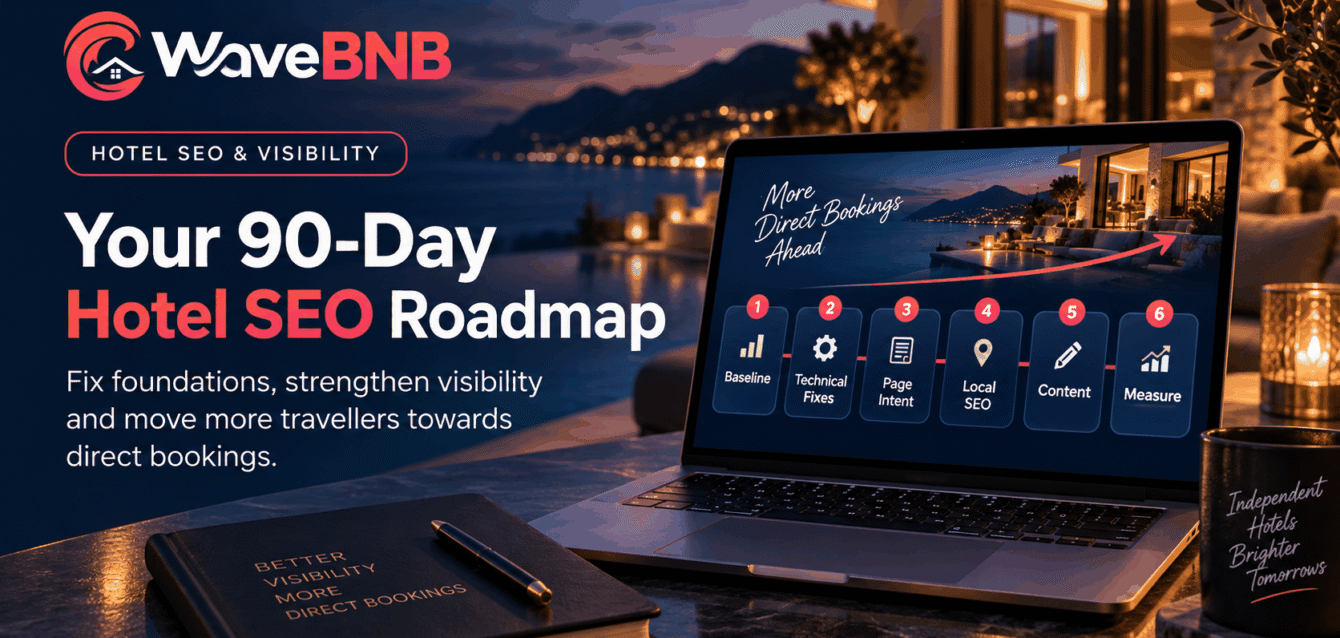
This 90-day hotel SEO strategy gives owners, general managers, commercial leaders and hotel marketers a practical order of operations. It prioritises the foundations first, then commercial search intent, local visibility, content authority, AI-search readiness and measurement.
What should a 90-day hotel SEO strategy include?
Direct answer: A strong 90-day hotel SEO strategy should do five things in order: establish a clean measurement baseline, remove crawl and indexation blockers, optimise the pages closest to a booking, strengthen local visibility through Google Business Profile, and build useful destination and guest-intent content around those commercial pages. In the final month, measure non-brand visibility, qualified organic traffic and booking actions, then use the data to prioritise the next quarter. Ninety days is enough to build the system and create early signals, but not to guarantee rankings or direct-booking revenue.
| By | Daniel Rey, Hospitality Growth Strategist, WaveBNB |
| Last updated | August 2026 |
| Experience | 9+ years’ experience building full-funnel acquisition, demand generation and conversion programmes across B2B SaaS, technology and hospitality, including SEO, paid acquisition, CRO, analytics, content strategy and AI automation, with experience managing multi-channel advertising budgets of up to £200k per month. |
| Editorial note | Content is reviewed and updated as search platforms, AI discovery, advertising systems, hospitality technology and digital marketing best practices evolve. |
| Sources | Google Search Central, Google Search Console Help and Google Business Profile Help resources cited throughout this article. |
About the author
Daniel is a senior growth and digital marketing strategist with 9+ years’ experience building full-funnel acquisition, demand generation and conversion programmes across B2B SaaS, technology and hospitality. His expertise includes SEO, paid acquisition, CRO, analytics, content strategy and AI automation, with experience managing multi-channel advertising budgets of up to £200k per month.
Through WaveBNB, his hospitality work covers hotel SEO and AI-search visibility, direct-booking growth, booking conversion, analytics and AI-powered guest experience automation.
Key takeaways
- Fix technical and indexation problems before scaling content. Publishing more pages on a weak foundation multiplies the problem.
- Prioritise pages closest to booking intent: the homepage, rooms, suites, amenities, offers, location and high-value experience pages.
- Treat Google Business Profile as part of hotel SEO, not as a separate local-marketing task.
- Build destination and guest-intent content as a supporting cluster that links into commercial pages rather than as an isolated blog calendar.
- Use AI-search optimisation as an extension of strong SEO and expert content. Avoid shortcut tactics that create thin or repetitive pages.
- Measure non-brand visibility, qualified organic sessions and booking actions. Rankings alone are not a commercial KPI.
Table of contents
- What should a 90-day hotel SEO strategy include?
- What a hotel SEO strategy should achieve
- Before Day 1: establish the baseline
- Days 1-15: fix crawlability, indexation and technical blockers
- Days 16-30: map search intent to commercial hotel pages
- Days 31-45: strengthen local SEO and Google Business Profile
- Days 46-60: build content clusters and internal links around guest intent
- Days 61-75: strengthen authority and AI-search visibility
- Days 76-90: measure, improve and connect SEO to direct-booking performance
- The 90-day roadmap at a glance
- How to prioritise if time or budget is limited
- Common hotel SEO mistakes to avoid
- What results should an independent hotel expect after 90 days?
- Frequently asked questions
- Build the system first, then improve it from evidence
- Next steps
What a hotel SEO strategy should achieve
A hotel SEO strategy is a prioritised plan for improving how a property is discovered in organic search and local results, how clearly search engines understand the hotel and its pages, and how effectively organic visitors move towards a direct booking. It combines technical SEO, commercial page optimisation, local search, content, authority and measurement.
For an independent hotel, the strategy should be organised around guest intent rather than generic keyword volume. Someone searching your property name is in a different stage from someone searching for a boutique hotel near a venue, a spa hotel for a weekend break or the best area to stay for an upcoming event. The website needs a clear page owner for each valuable intent and a logical path from discovery to rooms, offers or the booking engine.
Commercial principle: The goal is not to maximise organic traffic at any cost. The goal is to increase qualified visibility and help more travellers progress from search to a commercially relevant page, booking intent and, where attribution allows, direct-booking revenue.
Source: Google Search Central – SEO Starter Guide
Before Day 1: establish the baseline
Do not begin the 90-day plan by changing titles, adding keywords or commissioning ten new articles. First record the current position so you can tell whether the work is improving the hotel rather than simply creating activity.
Create a baseline for search and booking behaviour
- Google Search Console: record total clicks and impressions, then separate branded and non-branded demand where the report supports it. Capture the leading queries and landing pages.
- Analytics: record organic sessions to the homepage, room pages, offers, location and other high-intent pages. Separate mobile from desktop where possible.
- Booking journey: record booking-engine starts, completed bookings and direct-booking revenue from organic traffic where cross-domain tracking and attribution are reliable.
- Google Business Profile: record current profile completeness, hotel details, photos, reviews and available performance actions.
- Technical health: capture indexation issues, Core Web Vitals, broken internal links, redirects, duplicate URLs and the status of the XML sitemap.
Use the baseline to choose the commercial constraint. A property with strong branded traffic but almost no non-brand visibility needs a different plan from a hotel with strong traffic and a booking journey that fails on mobile.
Source: Google Search Console Help – Performance report tasks
Days 1-15: fix crawlability, indexation and technical blockers
The first phase is about making sure search engines can reliably access, interpret and index the pages you actually want travellers to find. Technical SEO does not need to become a months-long engineering project. Fix the issues that affect important templates and commercial URLs first.
Priority technical checks
- Confirm the preferred version of the site and review canonical tags on the homepage, room pages, offers and location pages.
- Check that important URLs are indexable and not blocked by robots.txt, noindex directives, password protection or accidental staging rules.
- Submit or validate the XML sitemap in Search Console and make sure it lists the canonical URLs you want indexed.
- Repair high-value 404s, broken internal links and redirect chains, especially links from navigation, destination guides and legacy campaign pages.
- Review Core Web Vitals on the highest-traffic mobile templates. Google currently defines good thresholds as LCP within 2.5 seconds, INP below 200 milliseconds and CLS below 0.1.
- Check whether the booking engine creates crawlable duplicate URLs or parameter combinations that should not compete with the main hotel website.
Do not chase a perfect technical score if the hotel already has a healthy, crawlable site. The purpose of this phase is to remove blockers and protect user experience, not to delay commercially important page work while minor warnings are polished.
Source: Google Search Central – Build and submit a sitemap
Source: Google Search Central – Core Web Vitals
Days 16-30: map search intent to commercial hotel pages
Once the foundation is stable, map the searches that matter to the pages most capable of producing booking intent. This is where hotel SEO stops being a generic content exercise and becomes a commercial architecture.
Build the hotel search-intent map
| Intent | Example search | Best page owner | Primary next action |
|---|---|---|---|
| Brand | [Hotel name] | Homepage / brand page | Check rates or book |
| Location | boutique hotel in [destination] | Homepage or location landing page | Explore rooms |
| Amenity / need | hotel with parking near [area] | Relevant amenity or room page | Check availability |
| Experience | spa weekend hotel [destination] | Experience / package / offer page | View offer or rooms |
| Venue / event | hotel near [venue] | Useful location or venue guide | View location and rooms |
| Research | best area to stay in [destination] | Destination guide | Move to relevant room / offer page |
Optimise the core pages before creating large volumes of supporting content. For most independent hotels, that means the homepage, room and suite pages, offers, location, key amenities, dining or spa pages where relevant, and any high-value meetings, weddings or experience pages that reflect real demand.
Each page should have one clear primary intent, a descriptive title and H1, original copy that answers the guest’s decision questions, useful images, obvious internal links and a visible booking path. Avoid creating a separate page for every tiny keyword variation. Google’s current guidance emphasises helpful, reliable, people-first content rather than search-engine-first page production.
Source: Google Search Central – Helpful, reliable, people-first content
Days 31-45: strengthen local SEO and Google Business Profile
For a hotel, local search is inseparable from organic visibility. Google states that local results are mainly based on relevance, distance and prominence. You cannot change the traveller’s distance from the property, so the work is to improve relevance and prominence with accurate information, a complete profile, strong website signals and genuine reputation.
Google Business Profile hotel checklist
- Claim and verify the hotel profile, then make sure the hotel name, address, phone number, website and category are accurate.
- Review hotel-specific amenities and attributes. Google provides hotel detail fields that can appear in Search and Maps.
- Check photos for quality, recency and accuracy. Remove outdated or misleading images where you control them.
- Review direct booking links and the data feeding hotel prices and availability. Google notes that hotel prices and booking links are supplied through Hotel Ads and free booking links.
- Build a consistent review-response process. Reviews support trust and are one of the signals Google references when explaining local prominence.
- Keep important hotel information consistent across the website and major travel, directory and partner sources.
Local SEO should also connect back to the website. The location page, contact details, directions, parking information, landmarks and relevant destination content should make it easy for both a traveller and a search engine to understand exactly where the property sits and what makes it relevant to the trip.
Source: Google Business Profile Help – Improve local ranking
Source: Google Business Profile Help – Manage hotel details
Days 46-60: build content clusters and internal links around guest intent
Only after the commercial pages and local foundations are in place should content production accelerate. The best hotel content does not exist to attract broad travel traffic with no path to booking. It answers real trip-planning questions and deliberately supports pages that can convert that interest.
Use a pillar-and-spoke structure
- Destination pillar: where to stay, neighbourhoods, transport, seasonal travel and essential planning information.
- Experience spokes: family weekends, romantic stays, wellness, food, outdoor activities or other themes the hotel genuinely serves.
- Venue and event spokes: major attractions, conference centres, wedding venues, stadiums or recurring events where the property has a real proximity or guest-use advantage.
- Commercial links: every guide should link naturally to the most relevant rooms, offers, amenities or location page rather than ending as a dead-end article.
Keep the content specific. Add first-hand property knowledge, realistic travel times, original photographs, practical recommendations and limitations. If a guide could be published unchanged by twenty hotels in the same city, it is unlikely to create much differentiation.
Build internal links with a purpose
Internal links should help the reader move from research to a more commercially relevant next step. A destination guide can link to a room type suited to families, a parking page can link to driving directions and the booking page, and an event guide can connect to an offer created for that period. Avoid adding keyword-rich links randomly across every page.
Source: Google Search Essentials
Days 61-75: strengthen authority and AI-search visibility
By this stage, the hotel should have a cleaner technical base, better commercial pages, stronger local information and a growing content system. The next phase is to improve trust, authority and the clarity of the hotel’s entity across search and AI-assisted discovery.
Build authority without link schemes
- Earn relevant local links and mentions through tourism organisations, event venues, attractions, suppliers, charities, awards and genuine partnerships.
- Create assets that are useful enough to cite, such as original local guides, accessibility information, event calendars, sustainability detail or first-party destination insights.
- Use clear authorship for editorial content and keep factual hotel information consistent across the site and external profiles.
- Use structured data that accurately represents visible page content. For the hotel site itself, LocalBusiness/Hotel or Organisation markup may be appropriate depending on implementation, while blog articles should use Article and BreadcrumbList where supported.
Treat AI search as an extension of good SEO
Google’s current guidance for generative AI features is clear: keep applying strong SEO fundamentals, create unique and useful content, maintain a clear technical structure and avoid chasing separate AEO or GEO hacks. For hotels, that means the most durable AI-search work is also useful to human travellers: precise property facts, clear definitions, concise answers, expert local knowledge, strong images, consistent entity information and pages that answer real questions completely.
Do not create dozens of near-duplicate pages simply to cover conversational query variants. Create one strong canonical page for each intent and make it genuinely useful enough to be referenced, summarised or recommended.
Source: Google Search Central – Generative AI optimisation guide
Days 76-90: measure, improve and connect SEO to direct-booking performance
The final phase turns the first 75 days into a repeatable operating system. The goal is to find where visibility is growing, where users are engaging, where the booking journey is leaking and which pages deserve the next investment.
Use a commercial hotel SEO scorecard
| Layer | Primary measures | What improvement suggests | Next decision |
|---|---|---|---|
| Visibility | Non-brand impressions and clicks; query coverage | More relevant discovery | Expand winning clusters |
| Engagement | Organic sessions to commercial pages; engagement | Traffic is reaching useful pages | Improve weak pages and links |
| Booking intent | Availability clicks; booking-engine starts | Organic traffic is progressing | Reduce friction before booking |
| Commercial | Direct bookings / revenue where attributable | SEO is contributing to owned demand | Increase investment in proven areas |
| Local | Profile actions, branded/local visibility, reviews | Stronger discovery around the property | Improve profile, reputation and local authority |
In Search Console, look for queries gaining impressions but underperforming on clicks, pages beginning to rank for valuable non-brand terms, and multiple URLs competing for the same query cluster. Google recommends focusing on trends in clicks and impressions rather than treating average position as the only performance measure.
Source: Google Search Console Help – Performance report
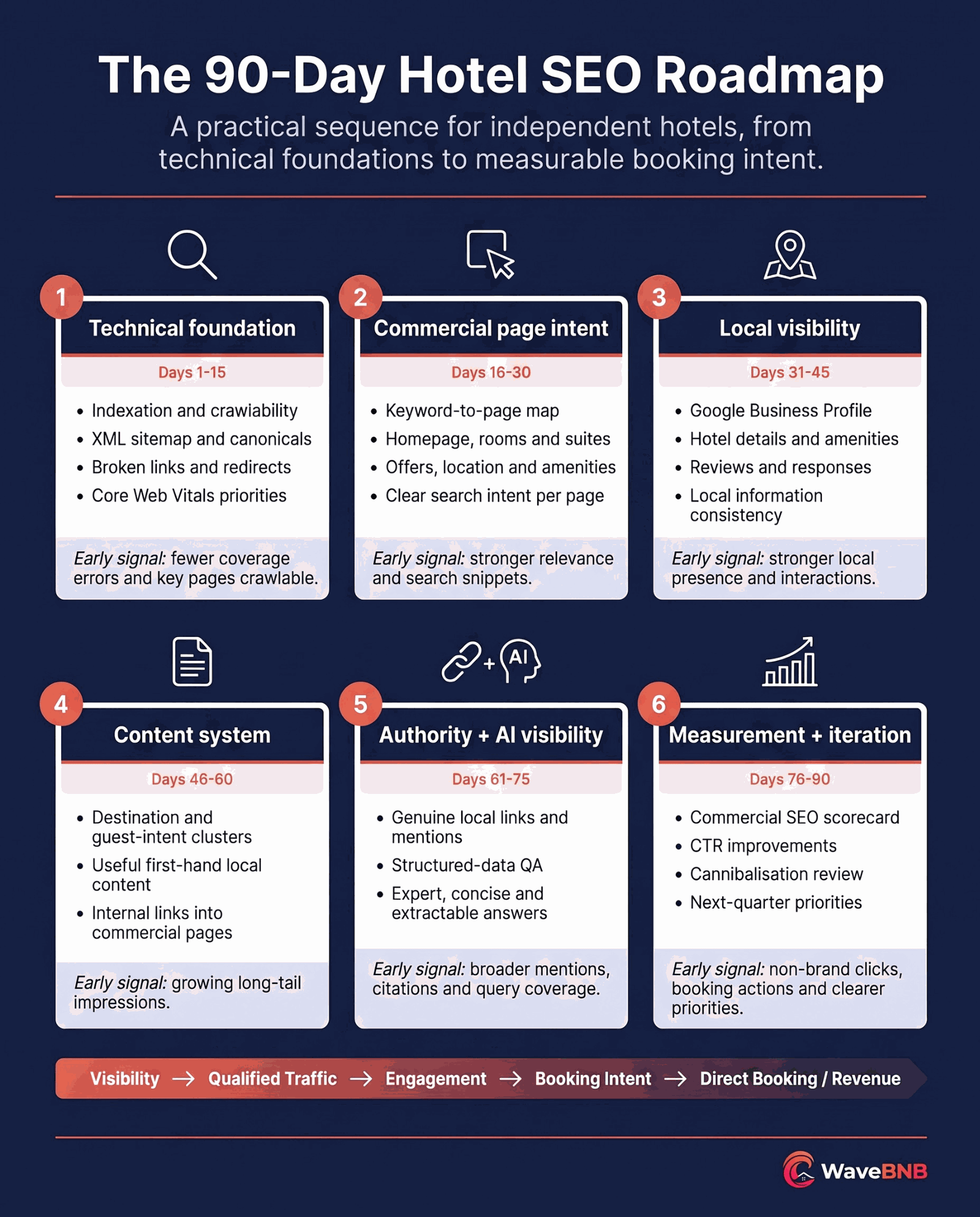
The 90-day roadmap at a glance
| Period | Priority | Core outputs | Early signals to watch |
|---|---|---|---|
| Days 1-15 | Technical foundation | Indexation, sitemap, canonicals, broken links, Core Web Vitals priorities | Fewer coverage errors; key pages crawlable |
| Days 16-30 | Commercial page intent | Keyword-to-page map; optimised homepage, rooms, offers, location and amenities | Improved relevance and search snippets |
| Days 31-45 | Local visibility | Verified, accurate Google Business Profile; hotel details; reviews; local consistency | More complete local presence and interactions |
| Days 46-60 | Content system | Destination and guest-intent clusters; purposeful internal links | Growing long-tail impressions and commercial page support |
| Days 61-75 | Authority + AI visibility | Local authority assets; structured data QA; expert, extractable answers | Broader citations, mentions and query coverage |
| Days 76-90 | Measurement + iteration | Commercial scorecard; CTR fixes; cannibalisation review; next-quarter plan | Non-brand clicks, booking actions and clearer priorities |
How to prioritise if time or budget is limited
Independent hotels rarely have unlimited development time, content capacity or specialist support. If the team can only complete a fraction of the roadmap, use this order:
- Fix anything preventing important pages from being crawled, indexed or used effectively on mobile.
- Improve the pages closest to revenue: homepage, rooms, suites, offers, location and the booking path.
- Complete and maintain Google Business Profile and hotel-specific details.
- Create one high-value content cluster around real guest intent and link it into commercial pages.
- Strengthen authority and expand only after the earlier layers are working and measured.
This sequence keeps SEO connected to the commercial journey: visibility, qualified traffic, engagement, booking intent and direct revenue.
Common hotel SEO mistakes to avoid
- Publishing large numbers of articles before fixing technical or commercial-page problems.
- Using the same generic destination copy that appears across dozens of hotel websites.
- Creating thin city, neighbourhood or amenity pages only because a keyword exists.
- Changing titles and headings repeatedly without recording a baseline or allowing enough time to measure the effect.
- Optimising only for rankings while ignoring whether organic visitors reach rooms, offers or the booking engine.
- Treating Google Business Profile, reviews and hotel details as a one-off setup task.
- Chasing AI-search shortcuts instead of building accurate, expert and genuinely useful content.
- Adding structured data that does not match visible content or assuming schema guarantees a rich result.
- Allowing multiple articles and landing pages to compete for the same primary intent without a canonical owner.
What results should an independent hotel expect after 90 days?
A 90-day SEO programme should be judged first by whether the system is healthier and the right signals are moving, not by a promised ranking position. Google’s own SEO guidance notes that some changes can be reflected quickly while others may take several months. Search is competitive, seasonality changes demand and each hotel starts from a different level of authority, technical health and content depth.
Reasonable early indicators include cleaner indexation, better Core Web Vitals on important templates, stronger local-profile completeness, rising impressions for non-brand queries, more qualified organic sessions to commercial pages and clearer data on booking intent. Material direct-booking impact may follow later, especially for new or low-authority sites.
A better 90-day question: Do not ask only, ‘Did our average ranking go up?’ Ask, ‘Are more relevant travellers discovering us, reaching the right pages and progressing towards a direct booking, and do we know what to improve next?’
Source: Google Search Central – SEO Starter Guide
Frequently asked questions
What is a hotel SEO strategy?
A hotel SEO strategy is a prioritised plan for improving a property’s organic and local search visibility, the quality of the pages travellers land on, and the path from search to booking intent. It usually combines technical SEO, commercial page optimisation, local search, content, authority and measurement.
How long does hotel SEO take to work?
There is no universal timetable. Google states that some changes may be reflected in hours while others can take several months. In the first 90 days, focus on building the foundation and measuring early signals such as indexation, non-brand impressions, clicks and qualified visits rather than expecting guaranteed revenue.
What should an independent hotel optimise first?
Start with crawlability and indexation, then the pages closest to a booking: the homepage, rooms, suites, offers, location and key amenities. After that, strengthen Google Business Profile and build supporting destination and guest-intent content.
Is Google Business Profile part of hotel SEO?
Yes. Google Business Profile affects how a hotel appears in Search and Maps, and Google explains local ranking mainly through relevance, distance and prominence. Hotel-specific details, amenities, reviews and accurate information should therefore sit inside the SEO operating plan.
How should a hotel measure SEO success?
Use a layered scorecard: non-brand impressions and clicks, qualified organic sessions to commercial pages, booking-engine starts and availability clicks, local profile actions, and direct bookings or revenue where attribution is reliable. Rankings are useful diagnostics, but they should not be the only success measure.
Build the system first, then improve it from evidence
The objective is not a temporary rankings spike. It is to build a repeatable organic growth system that can be improved quarter after quarter.
Then create the next 90-day plan from evidence. Keep what is compounding, refresh pages with improving impressions but weak CTR, consolidate overlapping content, improve the booking path where organic users drop out, and stop producing content that has no clear role in the commercial journey.
Next steps
Book a Growth Audit
Want a prioritised growth plan for your property? If your hotel already has traffic but it is unclear whether the problem is visibility, page structure, local search or booking conversion, start with a diagnostic rather than more content. Review the technical foundation, non-brand search demand, core commercial pages, Google Business Profile, internal links and the path from organic landing page to booking engine. Book a Growth Audit.
Explore Hotel SEO & Visibility
Or explore Hotel SEO & Visibility to see how WaveBNB approaches search visibility across Google, Maps and AI discovery.